
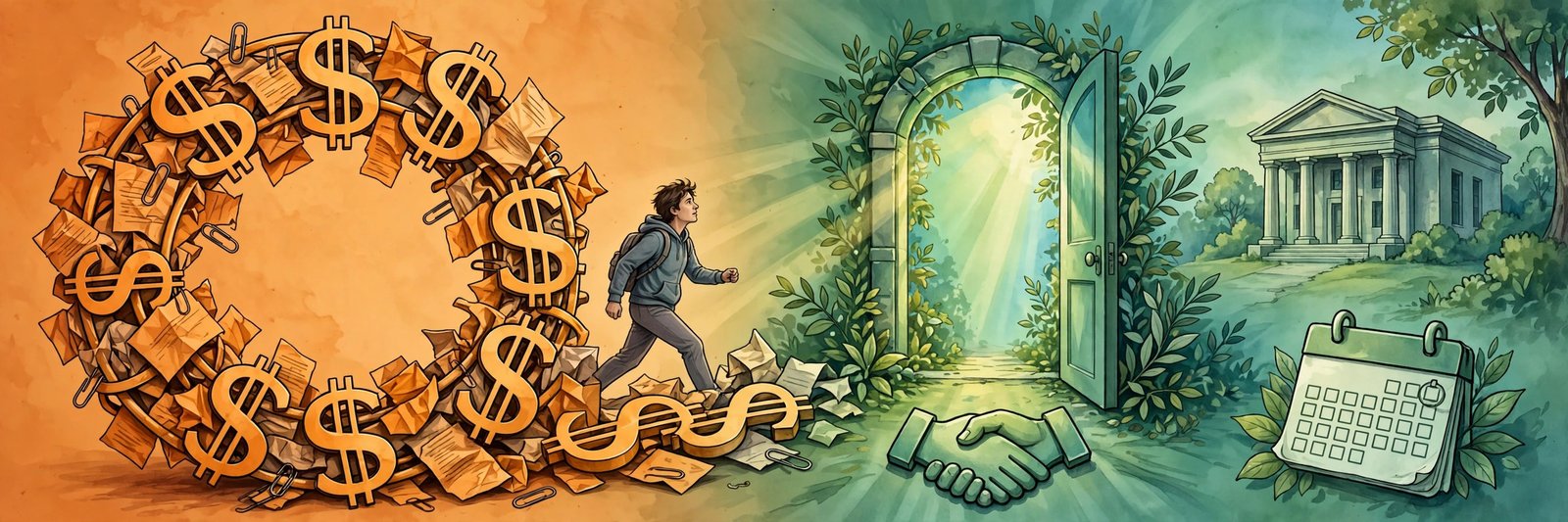
There is almost always a cheaper way out of a cash crunch than a payday loan — if you know where to look.
You need $500 before Friday. The payday loan store on the corner promises cash in minutes, no credit check, “just” a $75 fee. That $75 fee on a two-week $500 loan works out to roughly 391% APR, and most borrowers cannot repay in two weeks.
This 2026 guide shows you precisely how payday loans trap borrowers (with real numbers), then walks through 7 cheaper alternatives with a side-by-side cost comparison.
Table of Contents
- How Payday Loans Work
- The Trap: A Worked Example
- Cost Comparison Table
- 7 Cheaper Alternatives
- The Real Math: What a Payday Loan Costs Over a Year
- Why People Still Take Them (and the Psychology Lenders Exploit)
- PALs in Detail: How to Actually Get One
- Employer Advances and Earned-Wage Apps: Read the Fine Print
- What to Do If You Are Already in the Payday Cycle
- Borrowing $500: The Full Cost Ladder
- FAQs
How Payday Loans Work
A payday loan is typically $100 to $1,000, due in full on your next payday within two to four weeks. The lender charges a flat fee ($15–$30 per $100 in the US) rather than quoting interest. No real credit check, approval in minutes.
The Trap: A Worked Example
Borrow $500, fee $75, due $575 in 14 days. APR = ($75÷$500)×(365÷14)×100 ≈ 391% APR. Most borrowers roll over: pay another $75 to extend. Rolled 6 times: $450 in fees, still owe $500.
Cost Comparison Table: Borrowing $500
| Option | Cost | APR |
|---|---|---|
| Payday loan (2 weeks) | $75 fee | ~391% |
| Credit union PAL | ~$43.51 total | 28% capped |
| Employer advance | $0–$8 | ~0% |
| Creditor payment plan | Often $0 | 0% |
7 Cheaper Alternatives
1. Credit union Payday Alternative Loans (PALs)
$200–$1,000, 1–6 months, APR capped at 28% plus max $20 fee. A $500 PAL at 28% over 3 months costs about $43.51 all-in.
2. Ask creditors for a payment plan
Hospitals, utilities, landlords often offer interest-free plans. Cost: usually $0.
3. 0% introductory APR credit card
$0 interest if repaid within promo period (12–21 months). See personal loan vs credit card.
4. Employer advance
Many employers advance paycheck at no cost. Earned-wage apps charge $1–$8.
5. Sell items or gig work
Raise $500 without interest. Compare time cost vs $75+ fees per two weeks.
6. Community assistance
Dial 211 (US) for local aid. Grants, not loans — never repaid.
7. Negotiate the expense down
Medical bills often reduced 20–50% by asking. Every dollar off is a dollar not borrowed.
The Real Math: What a Payday Loan Costs Over a Year
The trap example above shows $450 in fees after 6 rollovers. Stretch it further and the numbers get brutal: rolling a $500 loan every two weeks for a full year costs $75 × 26 = $1,950 in fees — nearly four times the amount borrowed — while you still owe the original $500.
The APR formula behind the 391% figure is simple:
APR = (Fee ÷ Amount borrowed) × (365 ÷ Days) × 100
For this loan: ($75 ÷ $500) × (365 ÷ 14) × 100 ≈ 391%. The fee looks small because it is quoted in dollars (“just $75”), not as a rate. Always convert any flat fee into an APR before comparing — a $75 fee for two weeks is not a $75 cost, it is a 391% yearly rate wearing a friendly disguise.
Why People Still Take Them (and the Psychology Lenders Exploit)
Nobody takes a 391% loan because the math looks good. They take it because of four pressures lenders design around:
- Speed: cash in minutes beats a bank’s two-week process when rent is due tomorrow.
- No credit check: borrowers with damaged credit feel they have no other door open.
- Small-dollar framing: “$75” sounds manageable; “391% APR” does not — which is exactly why the fee is quoted in dollars.
- Storefront access: payday shops sit in neighborhoods banks left, with longer hours and no appointment needed.
Knowing the trap does not remove the pressure, but it changes the question. Instead of “can I get $500 today?”, ask “which option costs least by Friday?” — and the alternatives below answer that question far better.
PALs in Detail: How to Actually Get One
Payday Alternative Loans from federal credit unions are the single best replacement for most borrowers. Under NCUA rules:
- PAL I: $200–$1,000, 1–6 months, APR capped at 28%, plus a maximum $20 application fee. You generally need to be a credit union member for at least one month.
- PAL II: up to $2,000, up to 12 months, same 28% cap and $20 fee, with no minimum membership waiting period.
How to get one: find a federal credit union near you (or one you can join online — many accept members nationally), open an account (often a $5–$25 deposit), and apply. The $500 PAL example in this guide costs about $43.51 all-in over 3 months — compare that with $75 every two weeks for a payday loan, and the PAL pays for itself by the second rollover you avoid. If your credit union does not offer PALs, ask about a small personal loan or a credit-builder loan — both usually beat payday terms.
Employer Advances and Earned-Wage Apps: Read the Fine Print
A true employer advance — your company paying you early from your own paycheck — usually costs $0 and is the best option on this list if your employer offers it. Ask payroll directly; many companies have a formal policy they do not advertise.
Earned-wage apps are different. They typically charge $1–$8 per advance, which sounds cheap — but watch for two add-ons: optional “tips” that function as fees (a $5 tip on a $100 advance is a 5% fee for a few days’ use), and monthly subscriptions ($10–$15 a month) that apply whether you borrow or not. An app used twice a month with tips and a subscription can quietly cost more than a PAL. Use the app’s no-tip, no-subscription path when one exists, and prefer a real employer advance whenever possible.
What to Do If You Are Already in the Payday Cycle
If rollovers are already eating your paycheck, breaking the cycle matters more than finding the next loan:
- Stop the rollovers. Each rollover is another $75 fee for zero progress on the principal. Paying the principal once hurts less than rolling forever.
- Revoke ACH authorization in writing. Tell the lender in writing that you withdraw permission to debit your account, and give a copy to your bank. This stops automatic debits from draining the next paycheck.
- Ask your bank to stop the debits. Banks can block specific ACH debits; ask for a stop-payment and note the lender’s name and amounts.
- Ask about an Extended Payment Plan (EPP). Some states require payday lenders to offer an EPP — a longer, no-fee repayment schedule — if you ask before defaulting. Rules vary by state, so ask the lender directly and check your state’s regulator.
- Call a nonprofit credit counselor. NFCC member agencies negotiate with lenders, build a debt management plan, and charge little or nothing. Avoid for-profit “debt settlement” firms that charge large upfront fees.
- Prioritize in this order: rent and utilities (eviction and shutoff risk), secured debts, then unsecured debts including payday loans. A payday lender cannot evict you — your landlord can.
Borrowing $500: The Full Cost Ladder
| Option | Cost for $500 | Why it sits here |
|---|---|---|
| Creditor payment plan | Often $0 | Hospitals, utilities, landlords frequently split bills interest-free |
| Employer advance | $0–$8 | Your own wages, early — no lender involved |
| 0% intro APR card | $0 if repaid in the promo window | Interest-free for 12–21 months, then the regular rate applies |
| Credit union PAL | ~$43.51 over 3 months | 28% APR cap plus max $20 fee |
| Credit card cash advance | ~$37.32 for 30 days | Cheaper than payday, but interest starts immediately plus a cash-advance fee |
| Payday loan (2 weeks) | $75 fee, ~391% APR | The most expensive option on the ladder |
| Payday loan rolled 6 times | $450 in fees, still owe $500 | The trap: fees multiply while principal never shrinks |
Work the ladder from the top down. Every step above a payday loan saves real money, and the top three usually cost nothing at all.
Frequently Asked Questions
What is APR on typical payday loan?
About 391% APR ($75 fee on $500 for 14 days).
Why debt trap?
Borrowers roll over, paying fees while principal never shrinks.
What is PAL?
Credit union loan: $200–$1,000, 1–12 months, 28% APR cap.
How much cheaper is PAL?
$500 PAL costs ~$43.51 total vs $75 every 2 weeks payday.
Can I get payday loan with bad credit?
Usually yes, but cost is extreme regardless.
What if cannot repay?
Rollover offered, account debited, debt to collections. Contact nonprofit counselor.
Are payday loans legal everywhere?
No. Some states/countries ban or cap heavily.
Cash advance better?
Usually yes: ~$37.32 for $500 at 30 days vs $75 payday fee.
What is 211?
US: dial 211 for local emergency assistance.
BNPL replace payday?
Single 0% pay-in-4 can work. Longer BNPL up to 36% APR.
Borrow from 401(k)?
Cheaper but lose growth, risk taxes/penalties. Last resort.
How stop cycle?
Stop rollovers, revoke debit auth, contact counselor, ask bank to stop debits.
How is payday loan APR calculated?
APR = (Fee ÷ Amount borrowed) × (365 ÷ Days) × 100. A $75 fee on $500 for 14 days gives ($75 ÷ $500) × (365 ÷ 14) × 100 ≈ 391%. Flat fees hide the rate — always convert before comparing.
Are payday loans legal in my state?
It depends. Some US states ban payday lending outright, others cap fees and rates heavily, and some allow it with few limits. Check your state regulator’s website before borrowing — an online lender licensed elsewhere may still be breaking your state’s law.
What is an Extended Payment Plan (EPP)?
In some states, payday lenders must offer an EPP: a longer repayment schedule with no additional fees, if you request it before defaulting. It converts the two-week balloon into manageable installments. Availability and terms vary by state, so ask the lender and your state regulator.
Can a payday lender garnish my wages?
Only with a court judgment, which requires suing you first — a lender cannot garnish wages just because a payment bounced. Threats of immediate arrest or garnishment are usually illegal intimidation; actual default goes through collections and, rarely, court.
What happens if I close my bank account to stop debits?
Closing the account stops the debits but does not erase the debt — the lender can send it to collections and report it to credit bureaus. The cleaner move is revoking ACH authorization in writing plus a bank stop-payment, then dealing with the balance through an EPP or a counselor.
What is the difference between a PAL and a payday loan?
A PAL is a credit union loan: $200–$2,000, 1–12 months, APR capped at 28% plus a maximum $20 fee, repaid in installments. A payday loan is a two-week balloon at roughly 391% APR. Same need, vastly different cost — which is why PALs top this guide’s list.
Are online payday loans different from storefront ones?
The cost is usually the same or worse, and the risks are higher: some online lenders operate from other states or countries to dodge your state’s caps, and their debit terms can be harder to stop. State-licensed storefronts are at least regulated locally — online, verify the license before borrowing.
Can I get a PAL with bad credit?
Often yes. Credit unions weigh membership and income more than a perfect score, and PALs exist precisely for borrowers banks turn away. A low score may mean a smaller amount or a shorter term, but the 28% cap still applies.
Does calling 211 cost anything?
No. Dialing 211 in the US connects you to a free, confidential local helpline that finds emergency aid — rent help, utility assistance, food support, and grants that never need repayment. It costs nothing and takes minutes.
Is buy-now-pay-later safer than a payday loan?
For a single purchase, usually yes: a pay-in-4 plan at 0% costs nothing if every installment is paid on time. But longer BNPL plans can charge up to 36% APR, and missed payments bring late fees and credit damage. BNPL beats payday; a PAL or a payment plan beats BNPL.