

By Adil Hussain
Adil Hussain has worked jobs in 25 countries.
Getting a loan in the US isn’t as simple as signing a paper and walking away with money. The documentation you present can make or break your application. Lenders use documents to measure creditworthiness, verify financial standing, and confirm you can repay.
This 2026 guide covers: why lenders ask for paperwork, six core document categories, master checklist table by loan type, digital submission rules, preparation timeline, mistakes that cause delays, and self-employed guidance.
Try it: check your EMI with our EMI Calculator and see if you qualify with our Loan Eligibility Calculator.
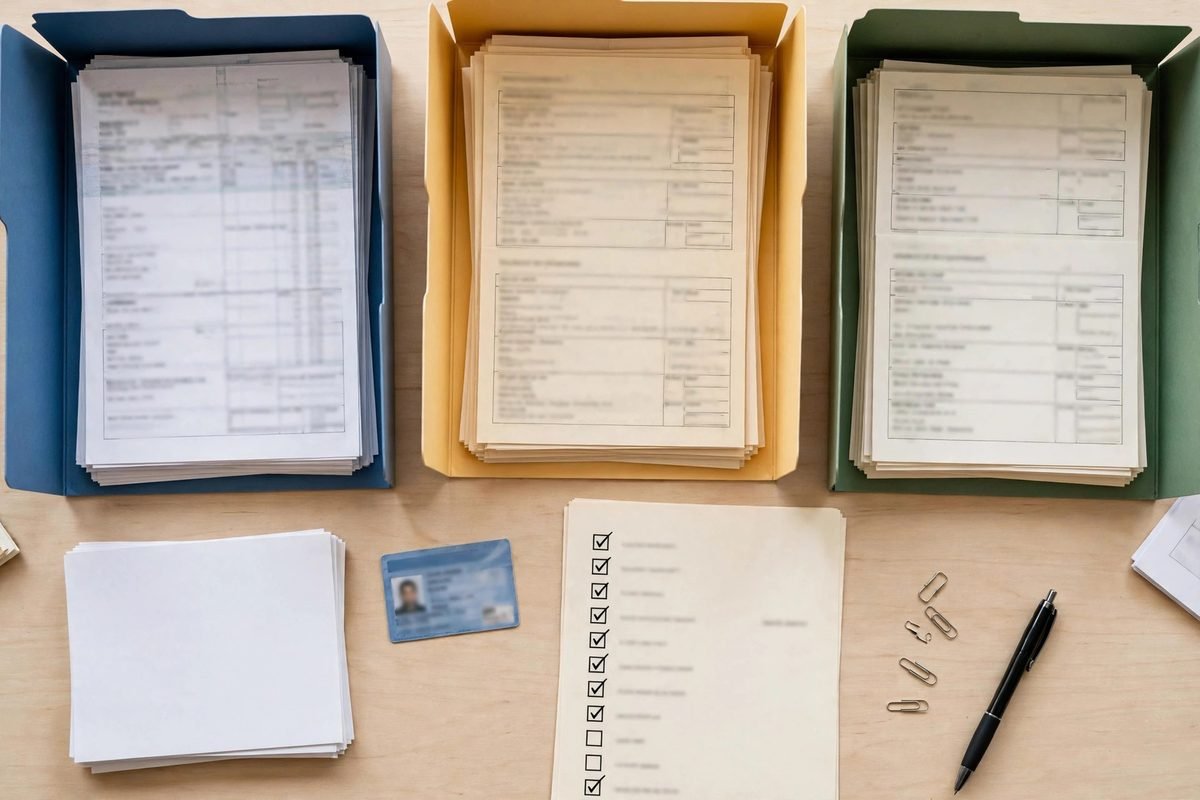
Key Takeaways
- The core package is the same everywhere: ID, income proof, address proof, bank statements, employment details and credit authorization.
- The Master Checklist shows which extras each loan type adds: tax returns and W-2s, a property appraisal for a mortgage, business financials for a business loan.
- The most common delays are a missing W-2 or 1099, unclear income for the self-employed, mismatched names and stale bank statements.
- For a mortgage, expect a credit check, appraisal and title search; for an auto loan, expect the vehicle title or lienholder information.
- Submit digital copies as high-quality scans of the complete page, and check the file size before uploading.
Contents
- Why Lenders Ask for Paperwork
- 1. Proof of Identity
- 2. Proof of Income
- 3. Credit Report
- Master Checklist Table
- Preparation Timeline
- 7 Mistakes to Avoid
- Self-Employed Guidance
- The Missing Categories: Address, Assets, and Collateral
- What Underwriters Actually Do With Your Documents
- Digital Submission Rules: Scans That Get Accepted
- Document Freshness Rules
- Explaining Red Flags Before the Underwriter Asks
- Mortgage-Specific Extras
- FAQs
Why Lenders Ask for All This Paperwork
Every document answers three questions: Who are you? (identity), Can you pay? (income vs debts), Will you pay? (credit history). Understanding this makes the checklist less arbitrary. Your credit score and DTI ratio matter as much as documents.
1. Proof of Identity
- Driver’s license or state ID
- Passport
- Social Security number
- Permanent resident card (if applicable)
Tip: Name must match exactly across all documents.
2. Proof of Income and Employment
- Pay stubs – last 30 days
- W-2 forms – last 2 years
- Tax returns – last 2 years (all pages)
- 1099s – if contractor/self-employed
- Bank statements – last 2-3 months
- Employment verification – employer contact, job title, start date
3. Credit Report and Score
Lenders pull your credit to assess history. Check your own first and fix errors. See improvement guide.
Master Checklist by Loan Type
| Document | Personal | Auto | Mortgage | Business |
|---|---|---|---|---|
| Photo ID | ✓ | ✓ | ✓ | ✓ |
| SSN | ✓ | ✓ | ✓ | ✓ |
| Pay stubs (30 days) | ✓ | ✓ | ✓ | ✓ |
| W-2s (2 years) | ✓ | ✓ | ✓ | ✓ |
| Tax returns (2 years) | ✓ | ✓ | ✓ | ✓ |
| Bank statements | ✓ | ✓ | ✓ | ✓ |
| Proof of address | ✓ | ✓ | ✓ | ✓ |
| Business plan | – | – | – | ✓ |
| P&L statements | – | – | – | ✓ |
Download printable checklist (PDF)
Document Preparation Timeline
- 4 weeks out: Pull credit reports, gather IDs, locate tax returns.
- 2 weeks out: Collect pay stubs, bank statements, employment info.
- 1 week out: Organize in folder, verify names match, make copies.
- Day of: Bring originals + copies. Never submit originals you can’t replace.
7 Document Mistakes That Delay Applications
- Name mismatches across documents.
- Missing pages from bank statements/tax returns.
- Old documents (stubs >30 days, statements >3 months).
- Unverifiable income (cash without paper trail).
- Large unexplained deposits.
- Submitting originals instead of copies.
- Waiting until last minute to gather.
What to Do If a Document Is Missing
A missing document does not have to stop your application — lenders accept a named replacement for almost everything, but only if you offer it before they ask. Tell your lender up front which item is missing and what you are sending instead.
| Missing document | What to send instead |
|---|---|
| W-2 (lost, or employer closed) | IRS Wage and Income Transcript — free from irs.gov (Get Transcript), or ask the employer for a reissue |
| Recent pay stubs (new job, or paid in cash) | Employer verification letter on company letterhead stating job title, start date and pay, plus bank statements showing the deposits |
| Tax returns | IRS Tax Return Transcript (Form 4506-C through your lender, or Get Transcript yourself) — covers the same 2 years |
| Social Security card | The card itself is rarely required — your SSN is enough. If a lender insists, order a free replacement from the SSA |
| Proof of address (no bill in your name) | Bank statement, government mail, or a notarised letter from the homeowner plus a copy of their utility bill |
| Bank statement pages | Download the full PDF from your bank — screenshots and partial statements are rejected automatically |
| Business P&L (self-employed, no formal books) | CPA letter, 1099s and business bank statements; lenders average the income over 2 years |
| Divorce decree / bankruptcy discharge | Certified copy from the court clerk — a summary from you is not enough |
Two rules: never submit a document you altered to fill a gap — falsifying a loan application is a federal crime — and never wait for the underwriter’s condition letter. A one-line note (W-2 for 2024 unavailable — IRS transcript attached) saves a week of back-and-forth.
Special Case: Self-Employed
Need 2 years tax returns, P&L statements, 1099s, business bank statements. Lenders average your income over 2 years. Keep clean separation of business/personal finances.
Gig Workers and Freelancers
Lenders treat gig income like self-employed income: 1099s from each platform, 2 years of tax returns, and bank statements showing regular deposits. They average your income over 2 years and discount income with no paper trail — cash jobs that never hit your bank account count as zero. Keep business and personal money in separate accounts; mixed accounts slow verification.
Students and First-Time Borrowers
With little or no credit history, expect to show school enrolment verification, part-time job pay stubs, and a bank statement — and expect the lender to ask for a co-signer. A co-signer is not a reference: they submit the same full package (ID, income proof, credit authorisation) and are equally liable for the loan if you do not pay.
The Missing Categories: Address, Assets, and Collateral
The guide above covers identity, income, and credit in detail. Three more categories complete the picture — and they appear in the checklist table without explanation:
Proof of address. A utility bill, lease agreement, or bank statement from the last 60 days showing your name and current address. Lenders use it to confirm residence and to match you against fraud databases. A P.O. box alone usually does not count.
Asset and reserve statements. Investment, savings, and retirement account statements prove you have reserves — money left after closing that covers several months of payments. Mortgage lenders especially want to see reserves; strong reserves can offset weaker credit or a higher debt ratio.
Collateral documents. For secured loans, the asset itself needs paperwork: a vehicle title and registration for auto loans, a property deed, purchase agreement, and appraisal for mortgages, and insurance proof showing the lender as loss payee. Business loans add business licenses, articles of organization, and sometimes franchise agreements.
Business documents. Beyond the business plan and P&L in the table: business tax returns (2 years), a balance sheet, a debt schedule listing every business debt, and personal financial statements from each owner with 20%+ ownership (for SBA loans, all such owners sign guarantees).
What Underwriters Actually Do With Your Documents
Documents do not sit in a folder — each one triggers a verification step:
- Identity is matched against fraud databases and the credit bureaus. A name mismatch between your ID and your credit file is one of the most common first-round conditions.
- Income is recalculated, not accepted at face value. Underwriters use gross income, average variable income (overtime, bonuses, commissions) over two years, and discount income they cannot document. Cash income without bank deposits or tax returns usually counts as zero.
- Assets are sourced. Every large deposit in your bank statements needs a paper trail — a pay stub, a sale receipt, or a signed gift letter. Unexplained deposits are assumed to be borrowed money until proven otherwise.
- Liabilities are cross-checked. Your credit report’s debts are compared against what you declared. An undisclosed loan or a missed card payment found here can restart underwriting.
- Conditions follow. It is normal for underwriting to come back with conditions — requests for one more document, one more letter, one more statement. Fast, complete answers to conditions are what separate a two-week approval from a two-month one.
Digital Submission Rules: Scans That Get Accepted
Most lenders now take uploads, but sloppy scans cause the same delays as missing pages:
- Scan full pages, all of them. Bank statements and tax returns must include every page — including blank ones and the “this page intentionally left blank” pages. A missing page triggers a condition every time.
- PDF beats photos. If you must use a phone, use a scanner app (not the camera roll) so pages are flat, cropped, and legible, with no fingers, shadows, or cut-off edges.
- Name files clearly. “2024-W2-John-Smith.pdf” gets processed faster than “scan001.pdf” — and reduces the chance your file is matched to the wrong borrower.
- Use the secure portal only. Never email tax returns, pay stubs, or anything with your Social Security number. Lender portals are encrypted; email is not.
- E-signatures are valid for most loan documents under US law, but the final closing package for a mortgage usually still requires a wet signature or an approved remote-online-notarization session. Ask which applies to your loan.
Document Freshness Rules
Documents age out. The table below is the standard lenders apply:
| Document | How fresh it must be |
|---|---|
| Pay stubs | Last 30 days |
| Bank statements | Last 2-3 months, all pages |
| Tax returns / W-2s | Last 2 years |
| Proof of address | Within 60 days |
| Government ID | Unexpired |
| Employment verification | At application — and for mortgages, often re-verified days before closing |
The re-verification point matters: mortgage lenders commonly call your employer again just before closing. Changing jobs mid-process, or having your employer miss the call, can delay closing even after approval. Tell your lender about job changes immediately — surprises found by the lender are far worse than news delivered by you.
Explaining Red Flags Before the Underwriter Asks
A short, honest letter of explanation attached to your application prevents conditions later. Write one proactively for any of these:
- Large deposits: “The $8,000 deposit on March 3 was a gift from my father for the down payment” — plus a signed gift letter stating it is not a loan.
- Employment gaps: one paragraph explaining the gap (school, caregiving, layoff) and what you do now.
- Address changes: if you moved twice in a year, list the addresses and dates so the file matches the credit bureaus.
- Name changes: marriage or divorce paperwork linking the old name on older documents to your current legal name.
- Cash income: bank deposit history showing regular deposits, plus tax returns reporting that income. Undocumented cash is the hardest income to get counted — report it on taxes first, then it becomes provable.
A two-paragraph letter turns a red flag into a checked box. Silence turns it into a week of back-and-forth.
Mortgage-Specific Extras
Mortgages ask for everything above, plus:
- Purchase agreement and proof of earnest money deposit.
- Homeowners insurance binder naming the lender as loss payee.
- HOA documents and budget, if the property has an association.
- Gift letters for any down payment money that came from family.
- Divorce decrees, child support orders, and bankruptcy discharge papers if any apply — underwriters must see the court documents, not just your summary.
Gather these the day your offer is accepted, not the week before closing. Mortgage timelines slip most often on documents the borrower did not know existed.
Frequently Asked Questions
What documents for personal loan?
ID, SSN, pay stubs (30 days), W-2s (2 years), tax returns, bank statements.
Self-employed documents?
2 years tax returns, P&L, 1099s, business bank statements.
Originals or copies?
Copies for application; originals may be needed at closing.
How recent bank statements?
Last 2-3 months, all pages.
What if name differs?
Must match exactly. Update IDs first.
Do lenders verify employment?
Yes, often via direct employer contact.
What is proof of address?
Utility bill, lease, bank statement within 60 days.
Can I apply without SSN?
Difficult in US. ITIN sometimes accepted.
How long keep documents?
Keep copies of everything submitted.
Digital submissions ok?
Yes, most lenders accept secure uploads. Ensure clear scans.
What causes delays?
Missing pages, name mismatches, old documents.
Business loan extra docs?
Business plan, P&L, balance sheet, business tax returns.
Do I need to submit every page of my bank statements?
Yes — all pages, including blank ones. Lenders reject partial statements automatically, because a missing page could hide an overdraft, a loan deposit, or an undisclosed account. Download the full PDF from your bank rather than screenshotting pages.
What counts as proof of address?
A utility bill, lease agreement, or bank statement from the last 60 days showing your name and current address. A P.O. box alone usually does not qualify, and the address must match what is on your credit file or you will be asked to explain the difference.
Can I submit photos of documents from my phone?
Yes, if they are clear, flat, fully visible scans — use a scanner app rather than the camera roll. Cropped edges, shadows, fingers, or glare get rejected. PDF uploads through the lender’s secure portal are preferred over emailed photos, which you should never send for sensitive documents.
What is a verification of employment?
A check where the lender contacts your employer (or uses a service like The Work Number) to confirm your job title, start date, and income. For mortgages, it often happens twice — at application and again just before closing — so tell your lender immediately if you change jobs mid-process.
Why do lenders want two years of tax returns?
Because one year can be a fluke. Two years show stable, verifiable income, let underwriters average variable pay like bonuses and overtime, and expose income that tax returns do not support. Self-employed borrowers are judged almost entirely on these two years.
What if I am paid in cash?
Cash income counts only if it is documented: regular bank deposits plus tax returns reporting it. Undocumented cash is treated as zero income by underwriters. If you earn cash, deposit it consistently and report it — then it becomes provable income for your next application.
Do I have to disclose all my debts?
Yes. Lenders find them anyway through your credit report, and an undisclosed debt discovered in underwriting damages your credibility far more than the debt itself would have. List everything, including buy-now-pay-later plans and family loans that appear on your statements.
What is a gift letter?
A signed letter from the person who gave you down payment money, stating the amount, the date, and that it is a gift — not a loan to be repaid. Lenders require it because gifted money does not add to your debts, while borrowed down payment money does.
How long does document verification take?
With a complete, clean package: days for personal and auto loans, 2-4 weeks inside a mortgage process. With missing pages, mismatches, or unexplained deposits: each round of conditions adds days to weeks. Complete submissions are the single biggest speed factor you control.
Can documents expire during underwriting?
Yes. Pay stubs older than 30 days and bank statements older than 2-3 months go stale, and mortgage lenders re-verify employment before closing. If underwriting drags on, expect to supply fresh copies — another reason to apply with documents gathered, not half-gathered.