


An illustration of the two main debt-payoff strategies: the avalanche targets the highest interest rate first, while the snowball builds momentum from the smallest balance.
If you are juggling several credit card balances, the question is not whether to pay them off — it is which one to attack first. Two strategies dominate personal finance advice: the debt avalanche and the debt snowball. They use the exact same monthly budget but pay your cards off in a different order — and that order changes both the total interest you pay and how the journey feels.
In this 2026 guide, we explain both methods in plain English, run a full worked example with three real cards ($4,200 at 24.99%, $2,800 at 19.99%, and $1,100 at 15.99%) and a $500 monthly budget, compare the results month by month, and help you decide which method fits your personality. We also cover the psychology versus the math, common mistakes, a step-by-step plan you can start this week, and smart alternatives like balance transfer cards.
Table of Contents
- What Is the Debt Avalanche?
- What Is the Debt Snowball?
- Worked Example: $8,100 Across 3 Cards
- Avalanche vs Snowball: Head-to-Head Results
- The Psychology vs the Math
- Which Method Should You Choose?
- 8 Common Mistakes to Avoid
- Step-by-Step: Build Your Own Payoff Plan
- Alternatives Worth Considering
- Bottom Line
- FAQs
What Is the Debt Avalanche?
The debt avalanche is the mathematically optimal payoff order. You list all your debts by interest rate, highest first, and throw every spare dollar at the highest-rate balance while making minimum payments on the rest. When the highest-rate debt is gone, you roll its entire payment into the next-highest-rate debt — like an avalanche gathering speed downhill.
How the avalanche works, step by step
- List every debt with its balance and APR (annual percentage rate). If you are unsure what APR really means, read our guide: What Is APR on a Loan? Explained Simply.
- Order them by APR, highest to lowest.
- Pay the minimum on every card except the top one.
- Send every extra dollar to the highest-APR card.
- When it is cleared, take the full amount you were paying on it and add it to the minimum payment of the next card on the list. This “rollover” is what gives the method its name.
Because interest grows fastest on the highest-rate balance, killing that balance first minimizes the total interest across the whole plan. No other payoff order can beat the avalanche on total cost — it is the cheapest route by definition.
What Is the Debt Snowball?
The debt snowball — popularized by personal finance coach Dave Ramsey — ignores interest rates and orders debts by balance, smallest first. You attack the smallest balance with everything you have while making minimums on the rest. Each cleared debt is a quick win, and the freed-up payment rolls into the next debt like a snowball gathering size as it rolls.
How the snowball works, step by step
- List every debt with its balance.
- Order them by balance, smallest to largest.
- Pay minimums on all but the smallest.
- Attack the smallest balance with all remaining budget.
- Roll the freed payment into the next-smallest balance when one is cleared.
The snowball is deliberately not the cheapest route — it is the most motivating one. Clearing a whole card in a few months delivers a psychological reward that minimum-only payments never give, and that momentum keeps many people going when the math-first approach feels like a grind.
Worked Example: $8,100 Across 3 Cards
Let us run both methods on the same realistic scenario so you can see the exact difference. Meet our example borrower:
- Card A: $4,200 balance at 24.99% APR
- Card B: $2,800 balance at 19.99% APR
- Card C: $1,100 balance at 15.99% APR
- Total debt: $8,100 | Monthly payoff budget: $500
Assumptions for this model: each card’s minimum payment covers that month’s interest plus a $25 floor, rates stay fixed, no new charges are added, and the borrower never misses a payment. (Your real minimums and terms will differ — check your statements.)
Option 1: The avalanche (highest rate first)
Payoff order: Card A → Card B → Card C.
- Month 12: Card A ($4,200 at 24.99%) is cleared. Its ~$400/month payment now rolls into Card B.
- Month 19: Card B ($2,800 at 19.99%) is cleared. Everything now targets Card C.
- Month 21: Card C ($1,100 at 15.99%) is cleared. Debt-free.
Avalanche totals: 21 months, $1,548.11 in total interest, about $9,648 paid overall.
Option 2: The snowball (smallest balance first)
Payoff order: Card C → Card B → Card A.
- Month 4: Card C ($1,100 at 15.99%) is cleared — a quick first win. Its payment rolls into Card B.
- Month 12: Card B ($2,800 at 19.99%) is cleared. Everything now targets Card A.
- Month 22: Card A ($4,200 at 24.99%) is cleared. Debt-free.
Snowball totals: 22 months, $1,921.88 in total interest, about $10,022 paid overall.
What the numbers tell us
The avalanche wins on pure math: one month faster and $373.76 less interest on the same $500 budget. That $374 gap comes from one simple fact — the 24.99% card was allowed to sit and compound for 22 months under the snowball, versus being attacked from day one under the avalanche.
But notice how close the timelines are: 21 vs 22 months. When balances and rates are this close together, the snowball’s extra cost is modest. The real danger of the snowball appears when a huge high-rate balance sits untouched for years while you clear small low-rate debts first. Run your own numbers with our free Credit Card Payoff Calculator before deciding — the gap in your situation might be $50 or $5,000.
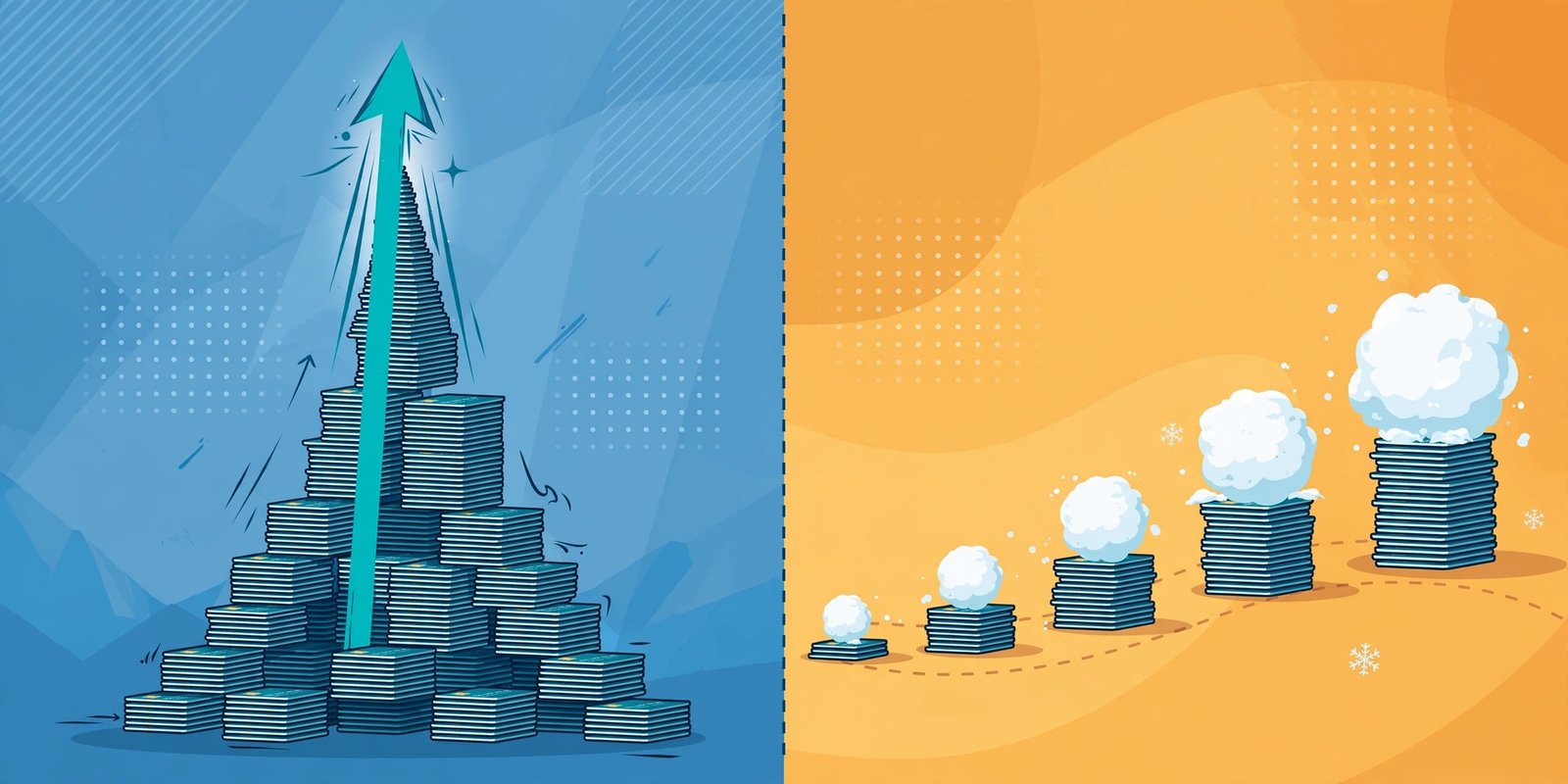
The two strategies side by side: avalanche strikes the highest-rate balance first, while snowball clears the smallest balance first for faster early wins.
Avalanche vs Snowball: Head-to-Head Results
| Debt Avalanche | Debt Snowball | |
|---|---|---|
| Payoff order | Highest APR first | Smallest balance first |
| Time to debt-free (our example) | 21 months | 22 months |
| Total interest (our example) | $1,548.11 | $1,921.88 |
| First card cleared | Month 12 (Card A) | Month 4 (Card C) |
| Best for | Disciplined payers who want the lowest cost | People who need quick wins to stay motivated |
| Main risk | Slow first win can feel discouraging | Costs more interest; big high-rate debts linger |
The Psychology vs the Math
Here is the honest truth: the avalanche is mathematically superior, but the snowball has helped millions of people actually finish. A 2016 Harvard Business Review study found that people who used the snowball method were more likely to become debt-free — not because it saves money, but because early wins build momentum.
The best method is the one you will actually stick with for 21+ months. If seeing a $0 balance in month 4 keeps you motivated, the extra $374 in interest is cheap. If you are disciplined and hate wasting money, the avalanche is your path.
Which Method Should You Choose?
Choose the avalanche if: you are disciplined, hate paying extra interest, and can wait 12 months for your first “paid off” win.
Choose the snowball if: you have struggled to stick with payoff plans before, need quick wins to stay motivated, or have several small balances that can be cleared fast.
Hybrid approach: Start with the snowball to clear 1-2 small debts for momentum, then switch to avalanche for the rest. You get the psychology AND the math.
8 Common Mistakes to Avoid
- Only paying minimums. Minimums are designed to keep you in debt for decades.
- Adding new charges while paying off. Freeze the cards.
- Ignoring the highest APR because the balance is scary. That is exactly why avalanche targets it first.
- Not having an emergency fund. One surprise expense and you are back to square one.
- Closing cards immediately after payoff. This can hurt your credit utilization.
- Choosing based on guilt instead of math or motivation. Be strategic.
- Forgetting to roll payments. When a card is cleared, that entire payment must go to the next target.
- Not tracking progress. Use our Credit Card Payoff Calculator to see your debt-free date.
Step-by-Step: Build Your Own Payoff Plan
- List all debts with balances, APRs, and minimum payments.
- Choose your method (avalanche, snowball, or hybrid).
- Set your monthly budget — be realistic but aggressive.
- Automate minimums on all cards to avoid late fees.
- Attack the target with everything above the minimums.
- Roll payments when a debt is cleared.
- Track monthly and celebrate each payoff.
Alternatives Worth Considering
- Balance transfer cards: 0% APR for 12-21 months can save hundreds, but watch the 3-5% transfer fee.
- Debt consolidation loan: One payment at a lower rate. See how to get the lowest rate.
- Negotiate with creditors: Sometimes they will lower your APR if you ask.
Bottom Line
Frequently Asked Questions
Which is better: debt avalanche or debt snowball?
The avalanche is mathematically better (saves the most interest). The snowball is psychologically better (faster wins). Research shows snowball users are more likely to finish, but avalanche users pay less. Choose based on what will keep YOU going for 20+ months.
How much money does the avalanche save vs the snowball?
It depends on your balances and rates. In our $8,100 example: $373.76 saved. With larger rate differences (e.g., 29% vs 12%), the gap can be thousands. Run your numbers in our Credit Card Payoff Calculator.
Can I switch from snowball to avalanche mid-payoff?
Absolutely. Many people start with snowball to clear 1-2 small debts for momentum, then switch to avalanche for maximum savings. There is no rule saying you must pick one forever.
Does the snowball method hurt my credit score?
No — paying down debts helps your score regardless of order. The method only changes which card gets extra payments first. What matters is: pay on time, pay more than minimums, and do not add new charges.
What if I have only one credit card debt?
Then avalanche vs snowball does not apply — you have one target. Focus on paying as much as possible above the minimum each month. Consider a balance transfer to 0% APR if you qualify.
Should I use savings to pay off credit cards?
Keep a small emergency fund ($500-$1,000) first, then attack high-interest debt aggressively. Credit card APRs (20-30%) almost always exceed savings account returns, so paying cards first is usually the winning move.