

- APR (Annual Percentage Rate) is the yearly cost of borrowing, expressed as a percentage — it bundles the interest rate plus most lender fees into one number.
- The interest rate prices only the interest; the APR prices interest and fees — making it the fairer comparison number.
- A lower rate does not always mean a cheaper loan — fees can wipe out a rate advantage, as the $15,000 example below proves.
- Your monthly payment is calculated from the interest rate, not the APR. APR is a comparison tool, not a payment formula.
- Compare APR to APR on identical terms — then verify total cost, since APR assumes you keep the loan full term.
- What APR Actually Means (Plain English)
- APR vs Interest Rate: A Worked $15,000 Comparison
- What APR Includes — and What It Leaves Out
- How APR Is Calculated (and Why Shorter Terms Show Higher APR)
- How APR Behaves on Credit Cards, Personal Loans, and Mortgages
- Variable APR, 0% Intro Offers, and Deferred-Interest Traps
- Checklist: Comparing Loan Offers by APR
- Common APR Mistakes to Avoid
- What to Do Next
- Frequently Asked Questions
One lender advertises a lower rate, another a lower APR — most borrowers mix the two up. The rate gets the big print; the APR reveals what the loan actually costs.
This guide explains APR in plain English — what it is, how it differs from the rate, which fees count, and how to compare offers — with fully worked examples.
What APR Actually Means (Plain English)
APR stands for Annual Percentage Rate. It is a standardized way of expressing the total yearly cost of borrowing money — the interest plus most of the fees the lender charges you — as a single percentage of the amount borrowed.
Think of it this way:
- Interest rate = the price of renting the money.
- APR = renting the money plus lender charges, as one yearly percentage.
APR exists so loans can be compared fairly. Without it, a lender could advertise a tempting 7% rate while quietly loading the loan with fees. In the United States, the federal Truth in Lending Act requires lenders to disclose the APR before you finalize a loan, calculated under one standard set of rules — that is what makes it your “apples to apples” number.
One critical detail: your monthly payment is calculated from the interest rate, not the APR. APR reveals the true yearly cost, but the payment leaving your account each month is driven by the rate in your loan agreement. Check both — the rate tells you your payment, the APR tells you the deal.
APR vs Interest Rate: A Worked $15,000 Comparison
Here is the side-by-side difference in one glance:
| Interest Rate | APR |
|---|---|
| The yearly price of borrowing the money itself | The yearly price of borrowing plus most lender fees |
| Ignores fees entirely | Includes origination fees, points, broker fees, and similar charges |
| Determines your monthly payment | Does not determine your monthly payment |
| Can look artificially low next to a competitor | The fair number for comparing two offers |
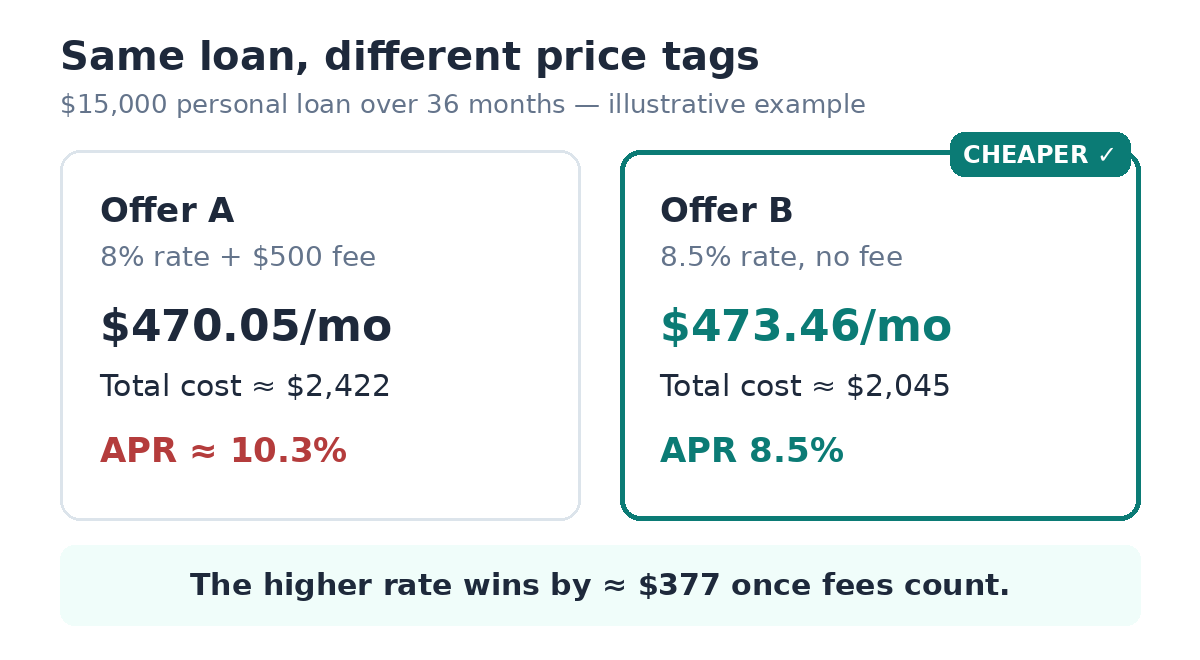
See it in action. You need $15,000 over 3 years (36 months) and receive two offers (illustrative example — real rates and fees vary by lender and credit profile):
- Offer A: 8.0% interest rate + $500 origination fee
- Offer B: 8.5% interest rate + $0 fees
Most borrowers would grab Offer A — the rate is lower! Let us do the math.
Offer A — 8% + $500 fee:
Monthly rate = 0.08 ÷ 12. Payment = $15,000 × 0.006667 ÷ (1 − 1.006667−36) ≈ $470.05/month.
36-month total = $16,922; interest = $1,922; plus the $500 fee → total cost ≈ $2,422. Spread the fee across the loan and the APR lands at roughly 10.3% — over two points above the advertised rate.
Offer B — 8.5%, no fees:
Monthly rate = 0.085 ÷ 12. Payment = $15,000 × 0.007083 ÷ (1 − 1.007083−36) ≈ $473.46/month.
36-month total = $17,045; interest = $2,045; no fees → total cost ≈ $2,045. APR = 8.5%, identical to the rate.
The result: Offer B — with the higher rate — costs about $377 less overall. The $500 fee erased Offer A’s rate advantage entirely. APR would have told you at a glance that Offer A (10.3% APR) was the worse deal.
Test your own numbers with our free EMI calculator — compare the total interest each offer produces.
What APR Includes — and What It Leaves Out
APR is a defined calculation: lenders must fold certain charges in and may leave others out. Knowing the split stops you assuming it captures literally everything.
| Usually INCLUDED in APR | Usually EXCLUDED from APR |
|---|---|
| Loan origination / processing fees | Property appraisal fee |
| Discount points (paid to buy the rate down) | Title search and title insurance |
| Mortgage broker fees | Credit report fee |
| Private mortgage insurance (when it is a required loan cost) | Government transfer taxes and recording fees |
| Prepaid interest charges | Optional insurance products you choose to add |
Two caveats: the exact list varies by loan type and country (the table reflects common U.S. practice — check your disclosure), and lenders can classify borderline charges differently. When two APRs are very close, compare the underlying fee breakdowns, not just the headline percentages.
How APR Is Calculated (and Why Shorter Terms Show Higher APR)
Skip the formula — the idea explains one of APR’s strangest behaviors. APR answers one question: “If upfront fees became extra interest spread evenly across the term, what single yearly rate gives the same total cost?” It uses the amount you actually receive and your real monthly payment, then solves for the balancing rate. Hence a $500 fee stings more on a short or small loan — the same fee spread over less time or money.
Watch it happen. Take a $10,000 loan at 7% interest with a $300 fee (illustrative example):
- 12 months: payment ≈ $865/month. The $300 fee is crammed into one year → APR ≈ 13%, nearly double the rate.
- 36 months: payment ≈ $309/month. Same fee spread over three years → APR ≈ 9%.
Same amount, rate, and fee — yet the shorter term shows a far higher APR: fixed fees weigh more over fewer payments. That is APR doing its job.
This also reveals APR’s biggest limitation: it assumes you keep the loan for its entire term. Repay early or refinance, and the fees spread over fewer months — making your effective cost higher than the disclosed APR implied. If you might exit early, compare total fees and early-exit costs directly instead of relying on APR alone.
How APR Behaves on Credit Cards, Personal Loans, and Mortgages
APR reads differently per product:
Credit cards. Here the APR and interest rate are usually the same thing — no upfront fees to fold in. But cards carry multiple APRs: purchase APR, balance-transfer APR (plus a transfer fee worth a few percent of the amount moved), cash-advance APR (typically the highest, with interest starting immediately and no grace period), and penalty APR after a late payment. One card, four prices of borrowing. See our personal loan vs credit card guide for which costs less on carried balances.
Personal loans. APR diverges most here because origination fees are frequently deducted from your proceeds: borrow $10,000 with a 5% fee and only $9,500 reaches you, yet you pay interest on the full $10,000. APR captures exactly that gap — the APR range in the fine print is the honest version of any “rates from X%” headline.
Mortgages. The widest rate/APR gap lives here — origination charges, points, broker fees, mortgage insurance. On a U.S. Loan Estimate, the rate sits on page 1 (“Loan Terms”) and the APR on page 3 (“Comparisons”): check both. And never compare a fixed-rate APR against an adjustable-rate APR at face value — the ARM’s APR does not reflect the maximum rate it can reach.
Auto loans. Dealers may quote a low rate while the APR quietly includes extras. Wait for the disclosure paperwork and compare APR to APR across lenders — our car loan guide explains dealer financing markups.
Student loans. Federal loans charge minimal fees, so APR hugs the stated rate. Private loans vary — some charge origination fees, some do not — making APR comparison especially valuable. Compare the two in our federal vs private student loans guide.
Variable APR, 0% Intro Offers, and Deferred-Interest Traps
Variable APR = a benchmark index (often prime) + a fixed lender margin (e.g. “prime + 8%”). It follows the index both directions, often starts lower, but can rise substantially. Never compare it at face value with a fixed APR — ask for the maximum rate (cap) and worst-case payment first.
0% intro APR offers are real — typically on cards for purchases or balance transfers, lasting months to over a year. The catches: a transfer fee worth a few percent of the balance, leftovers jumping to the regular APR at expiry, and promos cancelled by a missed payment. A timed tool, not free money — clear the balance before the clock runs out.
Checklist: Comparing Loan Offers by APR
Use this sequence whenever you compare offers:
- Compare APR to APR — never APR to interest rate. Mixing the two is the most common comparison error.
- Match loan type and term — APRs only compare on identical terms.
- Open the fee breakdown when APRs are close. Excluded borderline charges can flatter a quote.
- Note fixed vs variable — plus the index, margin, and maximum rate.
- Read intro-rate fine print: duration, fee, go-to rate, and what cancels the promo.
- Verify total cost with the EMI calculator — APR assumes you stay the full term.
- Stop if the APR on final documents exceeds your quote — surprise fees may have been added.
- Remember advertised APRs typically assume excellent credit — read the disclaimers.
Common APR Mistakes to Avoid
- Choosing by interest rate alone. The $15,000 example proved the lower rate can lose by $377 once fees count. Rate-only shopping is how fee-heavy lenders win.
- Assuming 0% means free. Transfer fees, deferred-interest clauses, and expirations mean “0%” always has a price tag. Read the terms, not the headline.
- Comparing APRs across different terms. A 12-month loan almost always shows a higher APR than a 36-month loan with identical fees. Compare like with like.
- Ignoring the variable-rate clause. A low variable APR today is a bet on tomorrow’s index. Know the cap and the worst case.
- Confusing APR with APY. APR prices borrowing; APY prices saving and investing, with compounding. Opposite directions — never cross them.
- Forgetting APR assumes full term. Refinancing or repaying early? The disclosed APR understates your true cost — compare fees and exit terms directly.
- Skipping the disclosure documents. The Loan Estimate and Truth in Lending disclosure standardize APR and fees. Never finalize without reading yours.
What to Do Next
You now know more about APR than most borrowers ever learn. Put it to work:
- List three numbers per offer: interest rate, APR, and total fees. No APR shown? Ask for it — disclosure is required.
- Rank by APR, then confirm by total cost. Line up APRs (same type, same term), then run the top two through the EMI calculator.
- Vet every 0%/”no interest” offer: true 0% APR or deferred interest? Note the fee, end date, and go-to rate — and calendar the payoff deadline today.
- Read the disclosure before signing. Does the APR match your quote? If it moved, find out why before proceeding.
- Keep going. Our personal loan vs credit card guide shows how APR plays out day to day across different debts.
Borrowing decisions are rarely reversed cheaply — ten careful minutes with APR is among the highest-paid ten minutes in personal finance.
Frequently Asked Questions
Is APR the same as the interest rate?
No. The interest rate is only the yearly price of borrowing the money. APR is the interest rate plus most lender fees (origination charges, points, broker fees) as one yearly percentage. With no fees, the two are identical — which is why they often match on credit cards but rarely on mortgages or personal loans.
Why is APR higher than the interest rate?
Because APR folds extra costs into the percentage: it spreads upfront fees across the loan term as if they were additional interest. More fees — or the same fees on a shorter term — push APR further above the interest rate.
Can APR ever be lower than the interest rate?
Essentially never on a standard loan, since APR starts with the interest rate and adds fees on top. If you see an APR quoted below the interest rate, treat it as a red flag and ask the lender to explain before proceeding.
What is a good APR for a personal loan?
There is no universal number — it depends on your credit profile, term, amount, and market conditions. Collect three or more offers for the same term, rank by APR, and use the lowest fairly-disclosed APR from a reputable lender as your benchmark. Advertised APRs typically assume excellent credit.
Does APR include every fee I will pay?
No. APR includes lender finance charges (origination fees, points, broker fees, required mortgage insurance, prepaid interest) but typically excludes third-party and government charges like appraisals, title searches, credit report fees, and transfer taxes. Always review the full fee schedule.
Is a 0% APR offer really free?
Not quite. No interest accrues during the promo window — but balance transfers usually carry a fee worth a few percent of the amount moved, the promo expires (leftovers jump to the regular APR), and a missed payment can cancel it early. Confirm the fee, end date, and go-to rate.
What is deferred interest, and how is it different from 0% APR?
Deferred interest — common in store financing and some medical cards — means “no interest if you pay in full before the promo ends.” If any balance remains, interest is charged retroactively on the entire original amount back to day one. With true 0% APR, leftovers simply start accruing interest going forward.
Fixed vs variable APR — which is better?
Neither suits everyone. Fixed APR never changes, so payments are predictable — ideal if you value certainty. Variable APR follows a benchmark index, so it can fall or rise, and often starts lower — suiting fast repayers. If you choose variable, know the index, margin, and maximum cap first.
Why does the same loan show a higher APR on a shorter term?
Fixed fees weigh more when spread over fewer payments. A $300 fee over 12 payments adds far more “extra interest per month” than the same $300 over 36 payments. In our example, $10,000 at 7% with a $300 fee showed roughly 13% APR on 12 months but about 9% on 36 months.
Is my monthly payment based on the APR or the interest rate?
The interest rate. Each payment is calculated from the rate in your promissory note; APR never changes the payment amount. It is a disclosure and comparison figure revealing the true yearly cost including fees. The rate tells you what leaves your account monthly; the APR tells you whether the deal is fair.
Where do I find the APR on a loan offer?
Lenders must disclose it in standardized documents. On a U.S. mortgage Loan Estimate, the rate is on page 1 (“Loan Terms”) and the APR on page 3 (“Comparisons”). For other consumer loans, it appears in the Truth in Lending disclosure before finalizing. Cannot find it? Ask — its absence is itself useful information.
What is the difference between APR and APY?
They measure opposite directions of money. APR is the yearly cost of borrowing — what you pay a lender. APY is the yearly return on saving or investing — what a bank pays you, including compounding. Compare APRs for loans, APYs for savings accounts.
Should I always pick the loan with the lowest APR?
Almost always — but verify two things. First, the APRs must cover the same loan type and term, or the comparison is invalid. Second, APR assumes you keep the loan for its full term; if you plan to repay early or refinance, compare total fees and exit costs directly too.
- Personal Loan vs Credit Card: Which Is Cheaper? — APR on revolving vs installment debt, compared.
- Car Loan Guide 2026 — dealer rates vs APR disclosures when financing.
- Free EMI Calculator — compare true borrowing costs for any rate, fee, and term.
Educational content only — not financial advice. Loan terms, rates, and fees vary by lender and borrower profile; always read your official loan disclosures. See our Financial Disclaimer.