
- Prepaying works because interest is charged on your outstanding balance — extra principal shrinks every future interest charge.
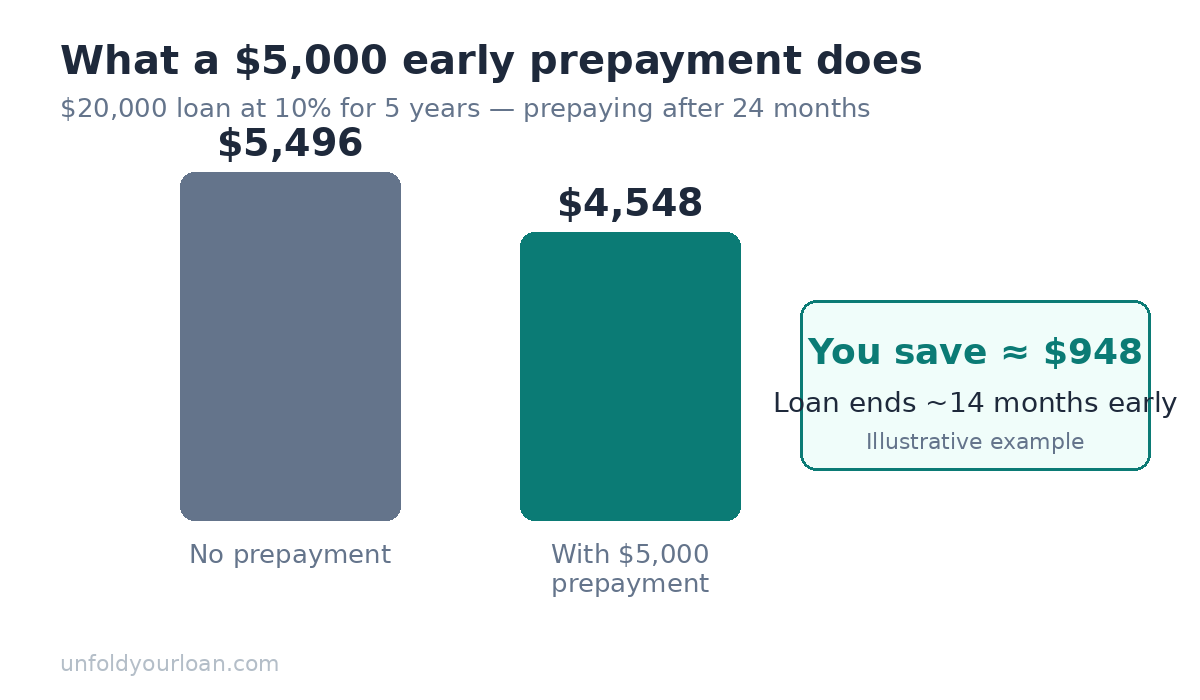
- Worked example: on a $20,000 loan at 10% for 5 years, prepaying $5,000 in year 2 saves roughly $950 in interest and ends the loan ~14 months early.
- Check for a prepayment penalty first — typically a % of the balance or a declining schedule (e.g. 3%/2%/1%). It can wipe out your savings.
- Don’t prepay with no emergency fund, while higher-interest debt exists, or with cash you’ll need soon.
- Prepaying earns a guaranteed return equal to your loan rate. Investing might earn more — but investment returns are never guaranteed.
- Confirm extra payments go to principal (not future installments) — and get a written payoff quote before a full payoff.
- How Prepayment Saves You Money (With Real Math)
- Partial vs Full Prepayment — and the EMI-vs-Tenure Choice
- Prepayment Penalties: What They Are and How to Check Yours
- When Prepaying Is the Smart Move
- When You Should NOT Prepay
- Prepay vs Invest: The Opportunity-Cost Framework
- How to Prepay the Right Way
- Common Mistakes to Avoid
- What to Do Next: Your Action Plan
- Frequently Asked Questions
You’ve got extra cash — a bonus, a tax refund — and you’re wondering: should I pay off my loan early? The instinct is usually right, but not always. The difference between a smart prepayment and a costly one comes down to a few details: the penalty clause in your loan agreement, what your other debts cost, whether you have an emergency fund, and what that money could do elsewhere.
This guide runs the real numbers so you can decide in about ten minutes — and tells you exactly what to ask your lender before sending an extra dollar.
How Prepayment Saves You Money (With Real Math)
On a standard amortizing loan, each month’s interest is charged on your current outstanding balance. Your fixed payment covers that month’s interest first; the rest reduces principal. So an extra payment toward principal doesn’t just lower what you owe — it shrinks every future interest charge. Prepaying early in the loan, when payments are interest-heavy, has the biggest effect.
The setup: $20,000 personal loan, 10% annual interest, 5-year term (60 payments).
- Monthly payment (EMI): ≈ $424.94
- Total paid: 60 × $424.94 = ≈ $25,496 → total interest ≈ $5,496
- First payment split: interest $166.67, principal only $258.27 — early payments are mostly interest
Now prepay $5,000 after 2 years (24 payments), step by step:
- Balance after 24 payments: ≈ $13,169.
- Apply the $5,000: new balance = $13,169 − $5,000 = ≈ $8,169.
- Keep paying $424.94/month. The loan now needs only ~22 more payments instead of 36 — it ends around month 46, roughly 14 months early.
- Total paid: $10,199 (first 2 years) + $5,000 + 22 × $424.94 (≈ $9,349) = ≈ $24,548.
- Interest saved: $25,496 − $24,548 = ≈ $948.
That $5,000 “earned” about $948 in avoided interest — a guaranteed, risk-free return. Notice the next payment’s split: interest is now only ≈ $68.08, leaving $356.86 for principal — versus $166.67/$258.27 at the start. Same payment, far more of it destroying principal.
Rounded estimates for illustration — model your own loan with our free EMI calculator.
Partial vs Full Prepayment — and the EMI-vs-Tenure Choice
- Partial prepayment: a lump sum (or regular extras) that cuts the balance; the loan continues. Most common — a bonus here, a refund there.
- Full prepayment (early payoff): you clear the entire balance at once. Always get a formal payoff quote first — the exact close-out amount on a specific date, since interest accrues daily.
After a partial prepayment, lenders usually offer a choice. Using our example ($8,169 balance, 36 months left):
| Option | Result | Interest saved |
|---|---|---|
| Shorten tenure (EMI stays $424.94) | Debt-free ~14 months early | ≈ $948 |
| Reduce EMI (term stays 36 months) | New EMI ≈ $263.60 — ~$161/month freed | ≈ $808 |
If you can afford the current EMI, shortening the tenure saves more. Reduce the EMI only if monthly breathing room matters more to you than the extra ~$140. Smaller regular extras work the same way — even an extra $100/month compounds into serious savings over a long loan.
Prepayment Penalties: What They Are and How to Check Yours
A prepayment penalty (or foreclosure charge) is a fee for paying off ahead of schedule. The lender priced your loan expecting years of interest; pay early and they lose it. The fee compensates them — and discourages prepaying. Structures vary by lender, loan type and country; typical patterns:
- Flat % of outstanding: e.g. 2% of the prepaid amount. On our $5,000 prepayment that’s $100 — well below the ~$948 saved, so prepaying still wins.
- Declining schedule: e.g. 3% in year 1, 2% in year 2, 1% in year 3, zero after — common on personal loans.
- Lock-in period: no prepayment (or a steep fee) during the first 6–12 months.
- Annual caps: e.g. penalty-free prepayment up to 25% of principal per year; fees only above that.
- No penalty: many lenders charge nothing — and in the US, federal rules have generally barred penalties on qualified mortgages issued after January 2014.
Check yours before anything else: (1) search your loan agreement for “prepayment,” “foreclosure,” or “early repayment”; (2) call your lender and ask how the fee is calculated and whether a lock-in applies — get it in writing; (3) do the net math: interest saved minus penalty = true benefit. If that’s near zero, don’t prepay.
When Prepaying Is the Smart Move
Walk through these in order. A “stop” at any step means fix that issue first:
- Emergency fund in place? If a surprise $1,000 bill would push you back into debt, stop. Keep 3–6 months of essentials in savings — cash locked into a loan is hard to get back. (If it’s an emergency — not spare cash — driving your decision, see our guide on emergency loan options.)
- No higher-interest debt? List debts by rate. Credit cards at ~24% beat a 10% personal loan every time — attack the expensive one first. (See our debt consolidation guide for prioritizing multiple debts.)
- Penalty math works? Interest saved minus penalty must be clearly positive — not marginal.
- Cash not needed soon? Down payment, tuition, medical costs in the next year or two — if the money has a job, keep it liquid. You generally can’t “un-prepay.”
- Investing isn’t clearly better for you? See the framework below.
Clear all five and prepaying is likely smart: a guaranteed return equal to your loan rate, a lower debt-to-income ratio, freed-up cash flow sooner, and real peace of mind.
When You Should NOT Prepay
- No emergency fund. Draining savings to kill a 10% loan, then borrowing at 24% for the next surprise, is a net loss.
- Higher-interest debt exists. Always rank by rate and attack the top — prepaying cheap debt while pricey debt compounds is mathematically backwards.
- The penalty wipes out the savings. Near-zero net benefit means paying for the privilege of being less liquid. Skip it.
- You’d lose a valuable tax deduction. Mainly a mortgage issue: if you itemize and the interest deduction meaningfully cuts your tax bill, count that lost benefit. (Rarely applies to personal loans.)
- The money is earmarked for a near-term goal — don’t prepay with it.
- Your rate is very low and you’re a disciplined investor. A 4–5% loan while steadily investing long-term can be legitimate — but only if the money actually stays invested. Be honest with yourself.
Prepay vs Invest: The Opportunity-Cost Framework
Core comparison: prepaying “earns” a return exactly equal to your loan’s interest rate — guaranteed and risk-free. Paying down a 10% loan is economically identical to a guaranteed 10% return. Investing offers only an expected return that is never guaranteed — markets fluctuate and you can lose money, especially short-term.
| Choice for the $5,000 | Outcome | Certainty |
|---|---|---|
| Prepay the 10% loan | Saves ≈ $948 interest; loan ends ~14 months early | Guaranteed |
| Invest (hypothetical 7%/yr) | ≈ $1,440 gain over ~3.8 years if markets cooperate | Not guaranteed — could be less or negative |
The hypothetical 7% looks better on paper — if you actually earn a smooth 7%, which never happens. The honest framework:
- High-rate loan (~10%+): prepay usually wins. A guaranteed 10%+ is extremely hard to beat at comparable risk. Kill the expensive debt.
- Mid-rate (~7–9%): genuinely close. Weigh risk tolerance and whether you’d truly invest the money rather than spend it. A 50/50 split is a fine compromise.
- Low-rate (~4–6%): investing often builds more wealth over 10–15+ years — historically speaking — but past performance guarantees nothing, and the money must actually stay invested.
- Always: never invest money you’ll need soon, never invest the emergency fund, and never treat a hoped-for return as equal to a guaranteed one.
Two nuances: taxes and account types change the math (tax-advantaged retirement accounts differ from taxable ones — rules vary by country), and an employer retirement match is an instant guaranteed return no loan can beat — grab the full match before prepaying. (General education, not tax advice.)
How to Prepay the Right Way
Don’t just “send extra money” — an unmarked extra payment may sit as credit toward next month’s bill instead of cutting principal, saving you nothing. Do this:
- Read the prepayment clause — penalty, lock-in, annual caps, notice requirements for full payoff.
- Call your lender: “Will an extra $5,000 reduce my principal, or count as advance installments?” You want principal reduction. Get the answer in writing.
- Mark the payment “principal only” (online memo, check line, or written instruction) and keep proof.
- For full payoff, get a formal payoff quote — the exact amount good through a specific date, including penalty and fees. Interest accrues daily; “current balance” isn’t the payoff figure.
- Verify the next statement: principal should have dropped by ~your extra amount (and the maturity date moved closer, if you chose tenure reduction).
- After full payoff, close the loop: written zero-balance confirmation; for secured loans, lien release and title documents. Keep records for years.
- Redirect the freed payment immediately — to the emergency fund, the next-highest-rate debt, or investments — before lifestyle spending absorbs it.
Common Mistakes to Avoid
- Draining the emergency fund to prepay. A 10% loan with no safety net is riskier than one with it. Fund first.
- Ignoring the penalty clause — then getting hit with a fee that erases the savings.
- Assuming extras auto-apply to principal. Some lenders advance your due date instead — balance and interest barely move. Always confirm.
- Prepaying cheap debt while expensive debt compounds. Rank by rate; attack the highest first.
- Full payoff without a payoff quote — residual interest/fees keep the loan open and accruing charges.
- Forgetting liquidity. Money in a loan is locked. If you might need cash within a year or two, think twice.
- Not checking the statement after. Misapplied payments happen — one five-minute check catches them.
What to Do Next: Your Action Plan
- Find your prepayment clause — penalty, lock-in, caps. (10 minutes.)
- List all debts by interest rate, highest first. Confirm nothing pricier outranks this loan.
- Check the emergency fund — below ~3 months of essentials? Fund it first.
- Run your numbers in our EMI calculator: interest saved minus penalty = true benefit.
- Call your lender — penalty? principal application? payoff-quote process? Get it in writing.
- Execute cleanly: “principal only,” keep proof, verify the statement, collect closure/lien-release documents on full payoff.
- Redirect the freed payment next month toward your next goal.
If the math favors prepaying and the checklist is clear, don’t overthink it — a guaranteed return at your loan rate plus less debt is a genuinely good outcome. If the math says otherwise, that’s equally valuable: now you know exactly where that money works harder.
Frequently Asked Questions
Is there a penalty for paying off a personal loan early?
Sometimes. Many lenders charge a prepayment fee — typically 1–5% of the outstanding balance where allowed, or a declining schedule like 3%/2%/1% in years 1–3. Some loans have a lock-in period; some lenders charge nothing. In the US, federal rules have generally barred penalties on qualified mortgages issued after January 2014. Check your agreement’s prepayment clause and confirm with your lender in writing before prepaying.
Does paying off a loan early hurt my credit score?
It can cause a small, temporary dip — closing an account may slightly reduce your credit mix and, eventually, average account age. But on-time history typically keeps reporting for years, total debt falls, and your debt-to-income ratio improves. Most borrowers see any dip fade within months. Exact impact varies by bureau and profile; treat this as a general pattern, not a prediction.
Should I pay off my loan early or invest the money?
Prepaying earns a guaranteed, risk-free return equal to your loan rate — killing a 10% loan is like earning 10% with zero risk. Investing offers only an expected return that is never guaranteed; you can lose money, especially short-term. Roughly: ~10%+ loans usually favor prepaying; ~4–6% loans often favor long-term investing for disciplined investors; the middle is judgment. Also weigh taxes, account types, and any employer retirement match — and never invest your emergency fund.
Is it better to make one lump-sum prepayment or small extra payments?
Earlier and larger wins mathematically — a lump sum today kills more future interest than the same total spread out, since interest accrues daily. But small, consistent extras beat nothing: $100 extra monthly compounds into real savings over the years. Use a lump sum if available and the checklist is clear; otherwise automate a monthly extra.
After a partial prepayment, should I reduce my EMI or shorten my loan tenure?
If you can afford the current EMI, shortening the tenure saves more — about $948 vs $808 in our $20,000 example — and gets you debt-free sooner. Reduce the EMI only if monthly breathing room matters more than the extra savings. Not all lenders offer both options, so ask.
How do I find out if my loan has a prepayment penalty?
Search your loan agreement for “prepayment,” “foreclosure,” or “early repayment” — the clause states the fee, lock-in, and caps. Then call your lender: is there a penalty, how is it calculated, any lock-in? Get answers in writing. Then do the net math: interest saved minus penalty = true benefit. Near zero or negative? Don’t prepay.
Will my lender automatically apply extra payments to the principal?
Not necessarily — a costly assumption. Some lenders treat extras as advance installments: your due date moves forward but principal and interest barely change. Ask explicitly, label the payment “principal only,” keep proof, and verify your next statement shows the principal drop.
How much can I actually save by prepaying my loan?
It depends on balance, rate, remaining term, and timing — earlier and larger saves more. Example: $20,000 at 10% over 5 years (≈ $5,496 total interest); prepaying $5,000 after two years saves roughly $948 and ends the loan ~14 months early. High rate, large balance, and early prepayment are the big drivers. Model your loan with an EMI calculator — figures are rounded estimates.
Should I use my emergency fund to pay off a loan early?
Generally no. The fund (typically 3–6 months of essentials) exists so surprises don’t force high-interest borrowing. Drain it to kill a 10% loan, then face a $2,000 emergency at 24% on a card, and you’ve lost overall. Fund first; prepay only from genuinely surplus cash.
If I have multiple debts, which one should I prepay first?
Rank by interest rate, highest first — each dollar saves the most there. Usually that means credit cards (~20–28%) before personal loans (~10–16%) before low-rate auto/mortgage debt. This “avalanche” approach minimizes total interest. (Smallest-balance-first “snowball” can aid motivation but costs more.) With several high-rate debts, see our debt consolidation guide.
Can I prepay a fixed-rate loan without a penalty?
Sometimes — it depends on your lender and agreement, not the rate type. Fixed-rate personal loans are actually among the most likely to carry penalties or lock-ins, since the lender locked in its expected income too. Floating-rate loans are more often penalty-free. Don’t assume: check the clause and confirm in writing.
What should I ask my lender before prepaying my loan?
Five questions, answers in writing: (1) Is there a prepayment penalty, and how is it calculated? (2) Any lock-in period or annual prepayment cap? (3) Will extra payments reduce principal or count as advance installments? (4) After partial prepayment, can I choose EMI reduction vs tenure shortening? (5) For full payoff, what’s the exact payoff quote good through which date? Then run the math — you’ll know precisely whether prepaying pays.
Educational content only — not financial advice. Loan terms, penalties, rates and tax treatment vary by lender and country. Figures are rounded illustrations, not predictions. See our Financial Disclaimer.