
- A mortgage is a loan secured by the home itself — stop paying and the lender can foreclose.
- Most monthly payments are PITI: Principal, Interest, property Taxes, and homeowners Insurance.
- Fixed-rate loans never change; adjustable-rate loans start lower but can rise.
- Less than 20% down usually means paying PMI until you reach enough equity.
- On a $350,000 home, 10% down, 6.5% 30-year fixed: about $1,991/month in principal and interest, but roughly $2,619/month all-in (see the worked example).
- What Is a Mortgage Loan?
- The Four Parts of Your Payment: PITI
- Fixed vs Adjustable Rates
- Down Payments: How Much Do You Need?
- PMI: The Cost of a Small Down Payment
- Escrow Accounts Explained
- Closing Costs
- Amortization: Why Early Payments Are Mostly Interest
- Worked Example: $350,000 at 6.5%
- How to Qualify in 6 Steps
- Common Mistakes to Avoid
- Alternatives
- Frequently Asked Questions
A mortgage is the largest loan most people ever take — yet many buyers understand only one number: the monthly payment. The taxes, insurance, fees, and the way the balance actually shrinks over time stay a mystery until something goes wrong. This guide explains how mortgage loans work in 2026, with real numbers throughout. If you are still deciding how much house to buy, read our home affordability guide first.
What Is a Mortgage Loan?
A mortgage is a loan for buying real estate where the property itself is the collateral — the security the lender can claim through foreclosure if you default. That collateral is the defining feature: it is why mortgages carry lower rates than unsecured borrowing like credit cards (more on that in our secured vs unsecured loans guide).
Two documents make it official: the promissory note (your promise to repay with interest) and the mortgage/deed of trust (the lender’s legal claim, or lien, on the property). You own and live in the home from day one, but the lien stays on the title until the loan is repaid — sell early and the lender is paid from the sale proceeds first.
Key terms: principal (amount borrowed = price minus down payment), interest rate (yearly borrowing cost), term (repayment period, commonly 15 or 30 years), down payment (upfront cash), equity (home value minus loan balance), and LTV (loan-to-value ratio — a $315,000 loan on a $350,000 home is 90% LTV).
The Four Parts of Your Payment: PITI
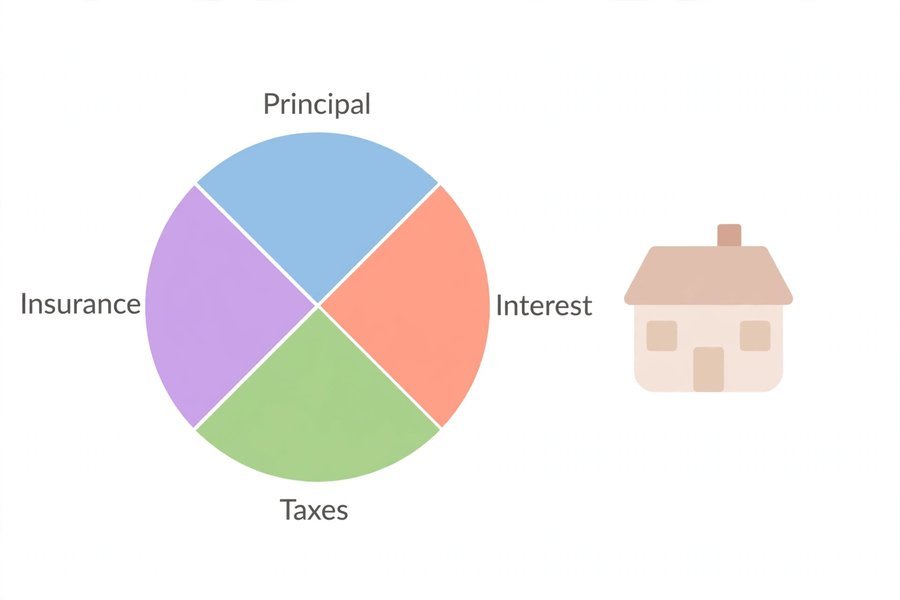
Your monthly payment is usually not just principal plus interest. Lenders bundle four components, remembered as PITI: Principal (reduces your balance), Interest (the lender’s charge, calculated on the remaining balance), property Taxes, and homeowners Insurance. Only P and I repay the loan — T and I are pass-throughs collected into escrow and forwarded to the tax authority and insurer.
Property taxes vary hugely by location — about 1% of the home’s value per year is a common US planning figure. Homeowners insurance typically runs $1,200–$2,400 per year for an average home. Together they can add several hundred dollars a month, as the worked example below shows.
Fixed-Rate vs Adjustable-Rate Mortgages
Fixed-rate mortgages lock your rate — and your principal-and-interest payment — for the entire term. A 30-year fixed at 6.5% costs the same in year 1 and year 29 (taxes and insurance can still drift). Adjustable-rate mortgages (ARMs) fix the rate for an initial period (5, 7, or 10 years — written 5/1, 7/1, 10/1), then adjust with market rates. ARMs start lower but can rise substantially; caps limit each adjustment and the lifetime maximum. See fixed vs variable rates explained for the full mechanics.
| Feature | Fixed-Rate | Adjustable-Rate (ARM) |
|---|---|---|
| P&I payment | Never changes | Can rise or fall at each adjustment |
| Starting rate | Higher | Usually lower |
| Best for | Long-term owners wanting predictability | Buyers likely to sell or refinance before the first adjustment |
| Main risk | Overpaying if market rates fall | Payment shock if rates rise later |
Down Payments: How Much Do You Really Need?
The 20% rule is outdated — several mainstream programs allow far less. A smaller down payment just costs more, via PMI and sometimes a higher rate.
| Program (US) | Minimum down | Notes |
|---|---|---|
| Conventional | 3–5% (20% avoids PMI) | Solid credit; primary homes |
| FHA | 3.5% | Lower credit OK; mortgage insurance required |
| VA | 0% | Eligible veterans; no monthly PMI |
| USDA | 0% | Eligible rural/suburban buyers; income limits |
The universal principle: a bigger down payment means a smaller loan, less lifetime interest, and usually a better rate — but draining your savings to hit 20% can leave you with no emergency fund. Balance both.
PMI: The Cost of a Small Down Payment
Private mortgage insurance (PMI) is insurance you pay that protects the lender if you default. On conventional loans it is generally required below 20% down, typically costing 0.3%–1.5% of the loan per year depending on down payment and credit score. On a $315,000 loan at 0.6%, that is about $158/month.
You can usually request cancellation at 80% loan-to-value, with automatic termination typically at 78% — confirm your servicer’s rules in writing. FHA loans charge their own premium (MIP), usually removable only by refinancing into a conventional loan. Dropping PMI once you reach 20% equity is one of the highest-return moves a homeowner can make.
Escrow Accounts Explained
An escrow (impound) account is a holding account your servicer manages: each month you pay roughly one-twelfth of your annual property tax and insurance bills into it, and the servicer pays those bills when due. It protects the lender’s collateral (unpaid taxes can outrank the mortgage; lapsed insurance leaves the house exposed) and turns lumpy annual bills into smooth monthly amounts.
Watch for the annual escrow analysis: if taxes or insurance rise, your payment adjusts up (shortage) or down (surplus). A surprise $80/month jump in year two is often escrow, not a rate change. With 20%+ equity on conventional loans you can sometimes waive escrow and pay the bills yourself — but then you must save for the lump sums.
Closing Costs
Closing costs are one-time fees to finalize the purchase — separate from the down payment. Expect roughly 2%–5% of the loan amount in the US: on a $315,000 loan, about $6,300–$15,750. The main items:
- Origination/lender fees — processing charges, sometimes quoted as discount points (pay ~1% of the loan upfront per point to buy down the rate).
- Appraisal fee — independent valuation confirming the home supports the loan amount.
- Title search & insurance — verifies clean ownership; insures against title defects.
- Prepaids — daily interest from closing to month-end plus 2–3 months of taxes/insurance to seed escrow.
- Recording & transfer taxes, attorney/settlement fees — government and closing-agent charges.
Whether discount points pay off is a break-even question — the same math as refinancing: divide the points cost by the monthly savings. In the US, compare the Loan Estimate (within 3 business days of application) against the Closing Disclosure (at least 3 business days before closing) line by line.
Amortization: Why Early Payments Are Mostly Interest
Amortization splits each fixed payment between interest and principal. The payment stays constant, but its composition shifts: interest is calculated on the remaining balance, largest at the start. On the $315,000 / 6.5% example: payment 1 = $1,706.25 interest + only $284.76 principal. After 5 years (~$119,461 paid), the balance is still about $294,875 — barely $20,125 of principal repaid. The final payments flip: nearly all principal.
Two consequences: extra principal payments early are extraordinarily powerful (see our prepayment guide), and selling in the first years builds little equity from payments — early equity comes mostly from the down payment and price appreciation. Model any scenario with our EMI Calculator.
Worked Example: $350,000 Home, 10% Down, 6.5% 30-Yr Fixed
Everything assembled, calculated with the standard amortization formula M = P × r(1+r)n / ((1+r)n − 1):
- Home price $350,000, 10% down ($35,000) → loan $315,000, 6.5% fixed, 360 payments
- Property tax 1.1%/yr → $3,850/yr = $320.83/mo; insurance $1,800/yr = $150/mo; PMI 0.6% of loan = $157.50/mo
Principal & interest: r = 0.065 ÷ 12, n = 360 → $1,991.01/month. Total PITI: $1,991.01 + $320.83 + $150.00 + $157.50 = $2,619.34/month.
| Component | Monthly | Share |
|---|---|---|
| Principal & interest | $1,991.01 | 76% |
| Property tax (escrow) | $320.83 | 12% |
| Insurance (escrow) | $150.00 | 6% |
| PMI | $157.50 | 6% |
| Total PITI | $2,619.34 | 100% |
Lifetime cost: $1,991.01 × 360 = $716,765 in P&I — $401,765 in total interest, more than the amount borrowed. That is the price of spreading a huge purchase over 30 years, and exactly why a lower rate, bigger down payment, or extra principal payments matter. Cash needed at closing: $35,000 down + $6,300–$15,750 closing costs + escrow prepaids — realistically $45,000–$55,000, not just the down payment.
How to Qualify in 6 Steps
- Strengthen your credit (2–6 months ahead). Even 0.5% of rate difference changes lifetime interest by tens of thousands. Dispute errors and avoid new debt — see our credit-score guide.
- Get pre-approved. A lender states what you could borrow after reviewing income, debts, and credit. Sellers prefer pre-approved buyers. It is not a final commitment.
- Shop 3+ lenders by APR. Rates and fees vary meaningfully — compare APR, not just rate, within a focused 2–3 week window so inquiries count as rate-shopping.
- Apply with documents. Photo ID, 2–3 months of pay stubs, 1–2 years of tax returns, bank statements, and down-payment source proof. Self-employed borrowers need more.
- Appraisal + underwriting. The lender verifies value and paperwork. Do not open new credit, change jobs, or make large unexplained deposits now — any can derail approval.
- Close. Review the Closing Disclosure, bring closing funds, sign the note and mortgage, get the keys.
Lenders also check your debt-to-income ratio (monthly debts ÷ gross income) — many programs cap it around 36–43%. Test yours with our loan eligibility calculator.
Common Mistakes to Avoid
- Budgeting on P&I alone — the “$1,991 payment” is really $2,619 with taxes, insurance, and PMI. Budget full PITI plus maintenance (~1% of home value/year).
- Draining savings for the down payment — keep 3–6 months of expenses liquid after closing.
- Skipping the rate shop — compare APRs across lenders; small differences compound enormously over 30 years.
- Big financial moves mid-process — new credit, job changes, or large deposits between application and closing can kill approval.
- Ignoring the ARM reset — know the first adjustment date, caps, and worst-case payment before signing.
- Forgetting PMI removal — at 20% equity, request cancellation in writing instead of paying $150+/month from inertia.
- Trusting “guaranteed approval” — upfront fees for guaranteed mortgage approval are a classic loan scam red flag.
Alternatives to a Traditional Mortgage
- 15-year fixed — higher payment, much lower rate and lifetime interest. Model it if your budget allows.
- FHA/VA/USDA programs — lower down payments, flexible credit; the trade-off is insurance costs.
- Seller financing — negotiable terms, fast closing, often higher rates; still get proper legal paperwork.
- Rent-to-own — part of rent builds toward purchase, but many contracts forfeit credits if you do not buy. Read carefully.
- Waiting and saving — a larger down payment later often beats a stretched purchase now.
Frequently Asked Questions
How much do I need for a down payment?
Conventional loans typically allow 3–5% down (20% avoids PMI), FHA allows 3.5%, and VA/USDA allow 0% for eligible borrowers. But the down payment is only part of the cash needed — closing costs (roughly 2–5% of the loan) and escrow deposits come on top.
What is PITI?
Principal, Interest, property Taxes, and homeowners Insurance — the four components most mortgage payments bundle. Principal and interest repay the loan; taxes and insurance are collected monthly into escrow and paid on your behalf.
Fixed-rate or adjustable-rate — which is better?
Fixed rates suit long-term owners who value predictability; the payment never changes. ARMs suit buyers who expect to sell or refinance before the first adjustment, trading a lower starting rate for later uncertainty. Compare the worst-case ARM payment, not just the teaser rate.
How does PMI work and when can I remove it?
PMI protects the lender (not you) when you put less than 20% down on a conventional loan, typically costing 0.3%–1.5% of the loan per year. You can usually request cancellation at 80% loan-to-value, with automatic termination typically at 78% — confirm your servicer’s rules in writing.
What are closing costs?
One-time fees to finalize the purchase — origination charges, appraisal, title insurance, prepaid interest, escrow deposits, and government fees — typically 2–5% of the loan amount in the US. Buyers usually pay most, though some items are negotiable.
Why is my early mortgage payment mostly interest?
Interest is charged monthly on the remaining balance, which is largest at the start. On a $315,000 loan at 6.5%, the first $1,991 payment holds about $1,706 of interest and only $285 of principal. As the balance falls, more of each payment attacks principal — this is amortization.
What credit score do I need?
Minimums vary by program, but a higher score always earns a better rate — and even a fraction of a percent changes lifetime interest by tens of thousands over 30 years. Improving your score before applying is one of the highest-value moves available.
What is an escrow account?
A holding account your servicer manages: each month you pay about one-twelfth of your annual property tax and insurance into it, and the servicer pays those bills when due. It protects the lender’s collateral and smooths lumpy bills into predictable payments.
Can I get a mortgage with no down payment?
VA loans (eligible veterans/service members) and USDA loans (eligible rural buyers) allow 0% down in the US; some conventional programs go as low as 3%. Zero-down means a bigger loan, more lifetime interest, and insurance costs — compare total cost, not just the entry price.
How long does approval take?
Typically 30–45 days from application to closing in the US, depending on the lender and how fast you supply documents. Pre-approval can take days; final approval waits on appraisal and underwriting.
What are discount points?
Optional upfront fees (usually 1% of the loan per point) that buy down your interest rate. They pay off only if you keep the loan past the break-even point — divide the points cost by the monthly savings to find it. Selling or refinancing sooner means skipping points.
Is 20% down always best?
It avoids PMI, usually earns a better rate, and shrinks lifetime interest — but not at the cost of your emergency fund. If 20% empties your savings or delays buying for years, a smaller down payment with PMI can be the rational choice.