

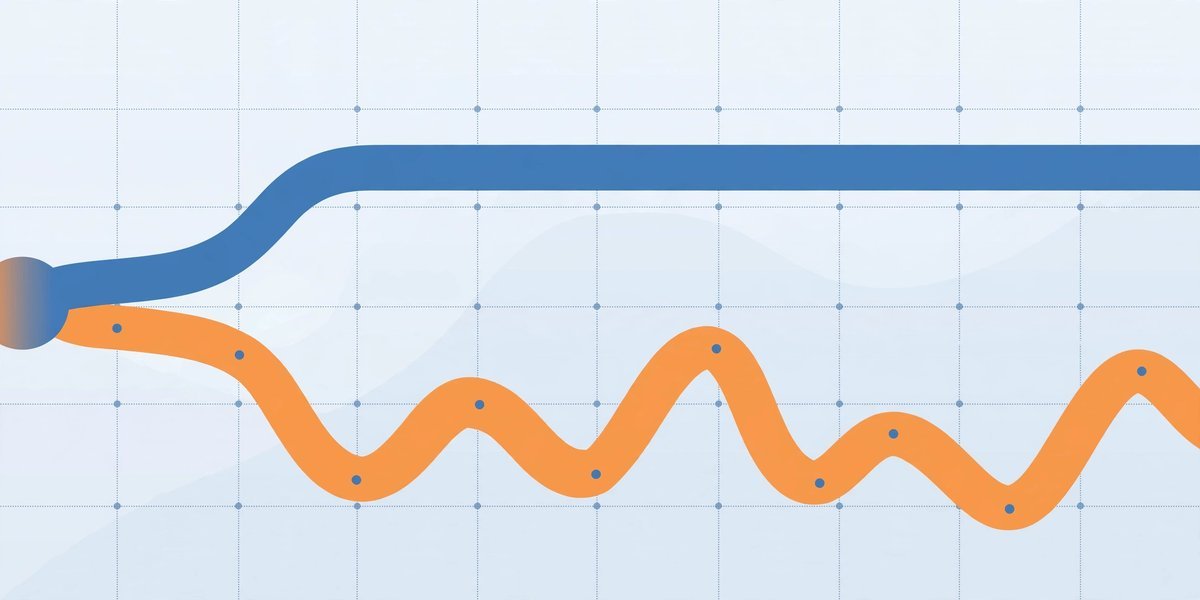
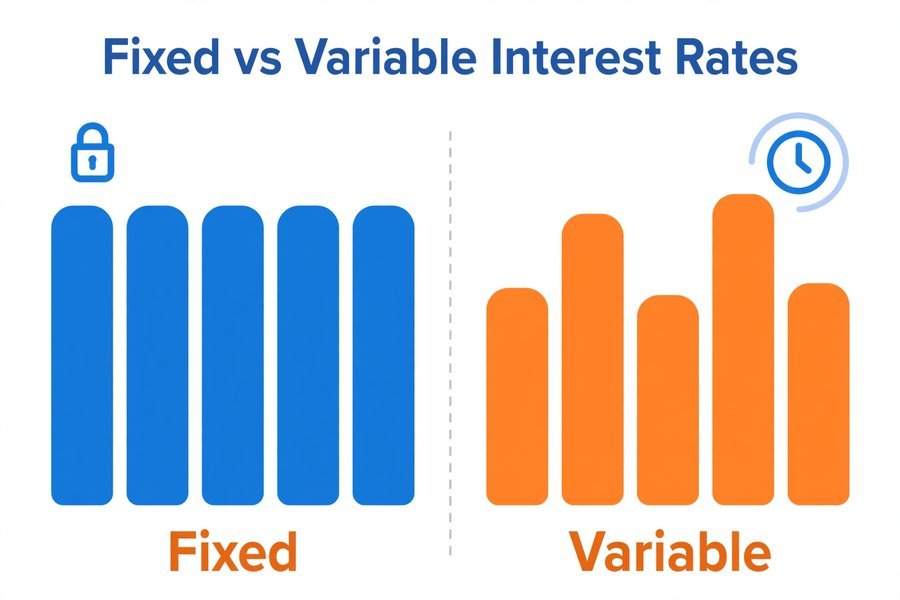
- Fixed rates never change — your payment is identical from the first month to the last.
- Variable rates start lower but adjust periodically with market rates, within set caps and floors.
- Variable rates are built from an index + margin (e.g., SOFR + 3%) and reset on a schedule.
- Worked example: on a $25,000 / 5-year loan, fixed at 9.5% costs $6,503 in interest; a variable rate starting at 7.5% costs $5,759–$6,474 depending on where rates go.
- Fixed wins on certainty; variable wins when rates stay low or you repay before adjustments bite.
- How Fixed Interest Rates Work
- How Variable Interest Rates Work
- Caps, Floors, and Margins: The Safety Rails
- Fixed vs Variable: Head-to-Head
- Worked Example: $25,000 Over 5 Years
- When Fixed Wins
- When Variable Wins
- How to Choose in 5 Steps
- Common Mistakes to Avoid
- Alternatives and Hybrid Options
- Frequently Asked Questions
Two borrowers take the same $25,000 loan. One pays the same amount every month for five years; the other’s payment shifts up and down like a tide. Neither chose wrong — they chose different rate types. Whether your interest rate is fixed or variable is one of the highest-impact decisions in any loan, shaping your budget’s predictability for years. This guide explains how each works, the caps and floors that bound variable rates, when each wins, and a fully worked dollar comparison.
How Fixed Interest Rates Work
A fixed interest rate is set once — at signing — and never changes for the life of the loan. Because the rate is constant, your scheduled payment is constant too (on an amortizing loan): the same dollars leave your account in month 1 and month 60. What changes inside the payment is the split between interest and principal — early payments are interest-heavy, later ones principal-heavy — but the total never moves.
Fixed rates dominate where certainty matters most: 30-year mortgages, auto loans, and most personal loans. The lender takes the interest-rate risk — if market rates rise, you keep your cheap rate; if they fall, the lender keeps your above-market payments (which is why refinancing exists). You pay for that certainty: fixed rates are usually set higher than the starting rate of a comparable variable loan, because the lender prices in the risk it absorbs.
How Variable Interest Rates Work
A variable (adjustable) interest rate has two phases: an initial period at a set starting rate, then periodic adjustments tied to the market. The new rate at each adjustment is computed from a simple formula:
Your rate = Index + Margin
- Index — a public benchmark that moves with the economy (in the US, often SOFR, the Secured Overnight Financing Rate, or the prime rate for credit cards). You cannot control it.
- Margin — the lender’s fixed markup, set at signing (e.g., 3%). This never changes.
So if the index is 4.5% and your margin is 3%, your rate becomes 7.5%. When the index climbs to 6%, your rate climbs to 9% — and your payment is recalculated. Adjustments happen on a schedule stated in the loan agreement: monthly (credit cards), annually, or after a multi-year fixed introductory period.
The classic structure is the hybrid ARM, written like 5/1: the rate is fixed for the first 5 years, then adjusts every 1 year after that. A 7/1 or 10/1 ARM works the same way with longer fixed periods. Learn how these play out on the biggest loan of all in our mortgage guide.
Caps, Floors, and Margins: The Safety Rails
Variable rates are not unlimited — three contractual guardrails bound them:
| Guardrail | What it limits | Example |
|---|---|---|
| Initial adjustment cap | How much the rate can jump at the first adjustment | Max +2% at first reset |
| Periodic cap | How much it can move at each later adjustment | Max ±1% per year after |
| Lifetime cap (ceiling) | The highest the rate can ever go | Never above start rate + 5% |
| Floor | The lowest the rate can ever go | Never below the margin, e.g. 3% |
Always find the lifetime cap before signing — it defines your worst case. Compute the payment at that ceiling (our EMI calculator makes it quick): if you cannot afford it, the loan is too risky for you regardless of the tempting start rate.
Fixed vs Variable: Head-to-Head
| Feature | Fixed Rate | Variable Rate |
|---|---|---|
| Rate movement | Never changes | Adjusts with index + margin |
| Monthly payment | Constant (fully predictable) | Changes at each adjustment |
| Starting rate | Higher | Usually lower |
| Risk bearer | Lender absorbs rate risk | You absorb rate risk |
| Best market | Rates low or expected to rise | Rates high or expected to fall |
Worked Example: $25,000 Over 5 Years
Same $25,000 loan, 5-year term, two rate choices — payments via the standard amortization formula:
- Fixed at 9.5%: $525.05/month, every month, for 60 months. Total interest: $6,502.79.
- Variable, starting at 7.5%: year 1 payment $500.95/month — $24/month cheaper than fixed, right away.
Scenario A — rates climb: after year 1 the rate adjusts to 10.5% for the remaining 48 months, payment $530.46/month. Total interest: $6,473.54.
Scenario B — rates stay moderate: rate adjusts only to 9.0%, $515.58/month for years 2–5. Total interest: $5,759.17 — about $744 less than fixed.
| Option | Monthly payment | Total interest |
|---|---|---|
| Fixed 9.5% | $525.05 (constant) | $6,502.79 |
| Variable: 7.5% → 10.5% | $500.95 → $530.46 | $6,473.54 |
| Variable: 7.5% → 9.0% | $500.95 → $515.58 | $5,759.17 |
The lesson: variable beats fixed only if rates cooperate. Never choose variable assuming the best scenario — budget for the capped worst case.
When Fixed Wins
- You need payment certainty. Tight budgets, fixed incomes, or long terms favor predictability.
- Rates are historically low. Locking a low rate permanently is the classic fixed-rate victory.
- Rates are expected to rise. If the trend is upward, variable’s starting discount gets eaten quickly.
- You will keep the loan full term. The longer the horizon, the more chances variable has to turn against you.
When Variable Wins
- You will repay or sell before the first adjustment. A 5/1 ARM held for 4 years is effectively a 4-year fixed loan at a discount.
- Rates are high but expected to fall. Variable lets you ride rates down without refinance closing costs.
- The starting discount is large. A 2%+ gap buys meaningful savings even if rates drift up moderately.
- You have payment flexibility. If you can absorb the capped worst-case payment comfortably, the risk is affordable.
How to Choose in 5 Steps
- Find the true fixed offer. Compare via APR, not just the rate.
- Read the variable guardrails. Index, margin, caps, floor. No caps in writing? Walk away.
- Price the worst case. If the lifetime-cap payment breaks your budget, choose fixed.
- Be honest about your horizon. “Probably” is not a plan.
- Check affordability with our loan eligibility calculator — at the start rate and the capped rate.
Common Mistakes to Avoid
- Budgeting on the teaser rate. The starting payment is temporary — budget the capped payment.
- Ignoring the margin. It is negotiable — negotiate it.
- Assuming you will refinance later. See our prepayment guide.
- Missing the adjustment date. Know exactly when the first reset hits.
- Not improving your credit first. See our credit-score guide.
- Trusting “rate protection” pitches blindly. Scam red-flag check.
Alternatives and Hybrid Options
- Hybrid ARMs (5/1, 7/1, 10/1) — fixed honeymoon, variable risk after.
- Shorter fixed term — a 15-year fixed often beats a 30-year ARM on rate and certainty.
- Rate buydowns and points — same break-even logic as refinancing.
- Offset accounts (UK/Australia) — offset savings against the mortgage balance.
Frequently Asked Questions
What is the difference between fixed and variable interest rates?
A fixed rate never changes, so your payment stays constant. A variable rate adjusts periodically based on index + margin, within caps.
What is a variable interest rate based on?
Index plus margin. The index is a public benchmark (SOFR, prime rate); the margin is the lender’s fixed markup.
Can a variable interest rate go down?
Yes — if the index falls, your rate falls at the next adjustment, down to the floor.
What are rate caps?
Initial cap, periodic cap, lifetime cap (ceiling), and floor. The lifetime cap defines your worst case.
Is it better to choose fixed or variable?
Fixed for certainty and long horizons; variable for short horizons or expected falling rates — if you can afford the worst case.
Why do variable rates start lower?
You absorb the interest-rate risk instead of the lender. The gap is the market price of that risk transfer.
What is a hybrid ARM like a 5/1?
Fixed for 5 years, then adjusting every 1 year. Blends early certainty with later variable pricing.
Can I switch from variable to fixed later?
Usually through refinancing — new application and closing costs.
Do fixed-rate loans ever change?
The rate and P&I payment never change; taxes, insurance, or PMI can still move the total.
What happens when my variable rate adjusts?
The lender recalculates rate = index + margin (within caps) and reprices your payment. Mark every adjustment date.
Are variable rates good when rates are falling?
Generally yes — your rate drops automatically, no refinance needed.
How do I compare a fixed vs variable offer?
Compare APRs, price the worst case at the lifetime cap, and weigh your horizon against the first adjustment date.