
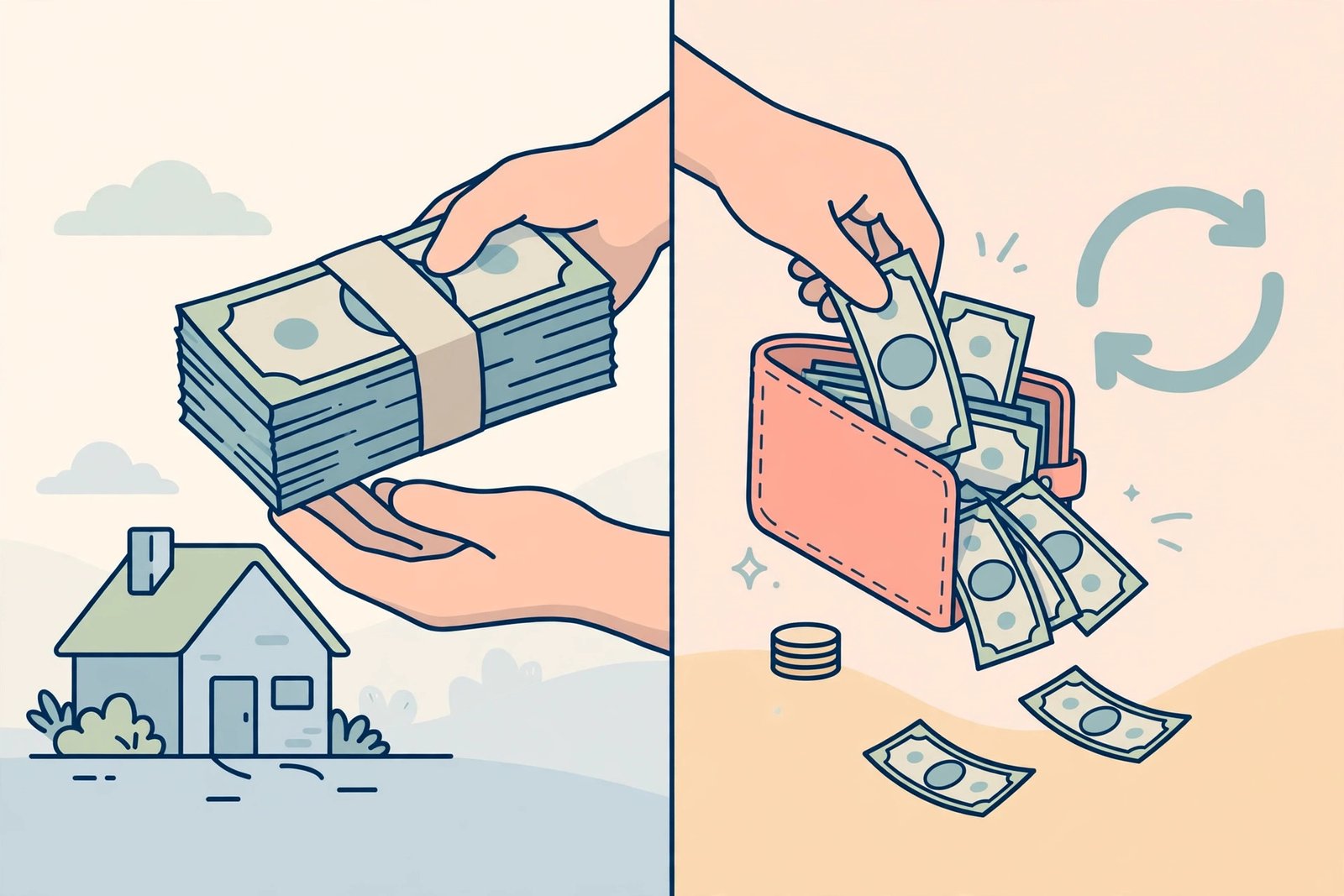
- A home equity loan gives one lump sum at a fixed rate with predictable payments — best for a single, known expense like a renovation.
- A HELOC is a revolving credit line with a variable rate — borrow, repay, and re-borrow during the draw period. Best for ongoing or uncertain costs.
- Worked math: on $50,000, a 10-year home equity loan at 8.5% costs ≈ $619.93/month and $24,391 in interest. A HELOC kept interest-only at 9% costs $375/month but leaves the full $50,000 still owed — then repayment-period payments can shock your budget.
- Both put your home on the line — miss payments and the lender can foreclose. Never borrow against your home for spending you could avoid.
- In the US, interest may be tax-deductible only when used to buy, build, or substantially improve the securing home — consult a tax professional; rules vary by country.
- Most lenders cap combined borrowing at 80–85% of your home’s value. Closing costs (2–5%) apply to home equity loans; HELOCs often have little or no closing cost.
- Home Equity Loan vs HELOC: The Core Difference
- How Each One Actually Works
- Side-by-Side Comparison Table
- Worked Cost Comparison: $50,000 at 8.5% vs 9%
- Fixed vs Variable Rates: What the Risk Really Is
- Closing Costs, Fees, and Tax Notes
- The Biggest Risk: Your Home Is the Collateral
- Which Should You Choose? 6 Real Scenarios
- Common Mistakes to Avoid
- What to Do Next: Your Action Plan
- Alternatives Worth Considering
- Frequently Asked Questions
Your home has gone up in value, and now you’re eyeing that equity like a savings account. Two products tap it — a home equity loan and a HELOC (home equity line of credit) — and they behave so differently that picking the wrong one can cost you thousands, or trap you in payment shock a decade from now.
This guide explains exactly how each works, runs the real numbers side by side, and matches six common situations to the right product.

Home Equity Loan vs HELOC: The Core Difference
Think of it this way. A home equity loan is one big ticket: the lender hands you a single lump sum, repaid in fixed monthly installments at a fixed rate — like a second mortgage. You know your payment on day one, and it never changes.
A HELOC works like a credit card secured by your house. The lender approves a maximum limit; you draw from it during the draw period (typically 10 years), paying interest only on what you’ve borrowed, and repaid amounts become available again. When the draw period ends, the repayment period begins (typically 15–20 years): no more draws, and the balance is paid down — often at far higher monthly payments than you got used to.
The one-line version: home equity loan = one lump sum, fixed payment, certainty. HELOC = flexible credit line, variable rate, payment-shock risk.
How Each One Actually Works
Home equity loan, step by step
- You apply for a specific amount — say $50,000 — backed by an appraisal, plus income, credit, and debt-to-income ratio checks.
- At closing you receive the full $50,000 in one transfer (minus closing costs paid upfront or rolled in).
- You repay in equal monthly installments over a fixed term — commonly 5, 10, 15, or 20 years — at a rate locked at closing.
- Interest accrues on the entire $50,000 from day one, whether you’ve spent it or not.
HELOC, step by step
- You’re approved for a limit — say $80,000 — based on the same underwriting.
- During the draw period (often 10 years), you borrow in chunks as needed: $20,000 for the roof this year, $15,000 for the kitchen next year. Minimum payments are often interest-only.
- Repaying a chunk frees that credit up again — borrow, repay, re-borrow, like a credit card.
- When the draw period ends, the repayment period starts (often 15–20 years). No more draws — the balance is amortized into principal-and-interest payments that can easily double or triple your monthly payment overnight. This is HELOC payment shock.
- The rate is variable, usually prime plus a margin — so your payment can rise or fall with market rates at any point.
How much can you borrow? Most lenders cap your combined borrowing (first mortgage + new loan/line) at 80–85% of the home’s appraised value. Example: $400,000 home, $280,000 mortgage. At 80%: $320,000 − $280,000 = $40,000 available. At 85%: $60,000 available. (If you’re buying rather than borrowing against, our home affordability guide covers the same math.)
Side-by-Side Comparison Table
| Feature | Home Equity Loan | HELOC |
|---|---|---|
| How you get the money | One lump sum at closing | Draw as needed during draw period |
| Interest rate | Fixed — locked at closing | Variable — moves with prime rate |
| Monthly payment | Fixed for the whole term | Changes with balance drawn and rate moves; jumps at repayment period |
| Interest charged on | Full loan amount from day one | Only what you’ve drawn |
| Can you re-borrow? | No — new application needed | Yes, during the draw period |
| Closing costs | Typically 2–5% of the loan | Often $0–low; may have annual fee |
| Best for | One-time, known cost (renovation, debt payoff) | Ongoing or uncertain costs (phased projects, tuition) |
| Main risk | Paying interest on money sitting unused | Payment shock + rate rises; easy to overspend |
Worked Cost Comparison: $50,000 Borrowed
Numbers make the trade-off concrete. Two realistic offers for the same $50,000 need — rates are illustrative; verify on lenders’ official sites.
Option A — Home equity loan: $50,000 at 8.5% fixed, 10-year term (120 payments).
- Monthly rate = 8.5% ÷ 12 = 0.7083%.
- Payment = $50,000 × [0.007083 × (1.007083)120] ÷ [(1.007083)120 − 1] = ≈ $619.93/month.
- Total paid = 120 × $619.93 = ≈ $74,391 → total interest ≈ $24,391, plus ~2–5% closing costs ($1,000–$2,500).
Option B — HELOC: $50,000 drawn at 9% variable (held constant here for comparison — in reality it moves), 10-year interest-only draw, then 20-year repayment.
- Draw-period payment = $50,000 × (9% ÷ 12) = $375/month — interest only.
- After 10 years you’ve paid 120 × $375 = $45,000 in interest and still owe the full $50,000.
- Repayment period: $50,000 over 20 years at 9% = ≈ $449.86/month × 240.
- Grand total over 30 years: $45,000 + $107,966 = ≈ $152,966 — versus $74,391 for the home equity loan.
Two lessons: interest-only is a trap if you don’t attack principal during the draw period — $45,000 paid, balance unchanged. And the disciplines differ: the home equity loan forces repayment; the HELOC requires you to impose it on yourself. (Amortize the HELOC over 10 years at 9% instead and it’s ≈ $633.39/month with ≈ $26,007 total interest — barely more than Option A, provided the rate never rises. That’s the variable-rate gamble.)
Rounded estimates for illustration — run your own numbers with our free EMI calculator.
Fixed vs Variable Rates: What the Risk Really Is
This is the heart of the decision. On a HELOC your rate is typically prime rate + margin — if prime is 8% and your margin is 1%, you pay 9%; if prime climbs to 10%, you pay 11% on the outstanding balance.
- Rate caps help, but don’t eliminate risk. Most HELOCs have a lifetime cap (often ~18% in the US) — but a jump from 9% to 12% on $50,000 adds $125/month in interest alone.
- The fixed-rate home equity loan is immune to all of this. 8.5% at closing means 8.5% in year 9, whatever markets do. That certainty has real value on a tight budget.
- Some HELOCs offer fixed-rate conversion — lock a drawn portion into a fixed rate for a fee. Useful, but check the fee and fine print.
Our fixed vs variable rates guide goes deeper. Rule of thumb: if you’d lose sleep over a rising payment, or your budget has no slack, lean fixed.
Closing Costs, Fees, and Tax Notes
Home equity loans carry closing costs — appraisal, origination, title — typically 2–5% of the loan. On $50,000 that’s $1,000–$2,500, paid at closing or rolled into the balance (meaning interest on the fees too).
HELOCs are cheaper to open — many lenders charge little or nothing. Watch for annual fees ($50–$100 common), inactivity fees, early termination fees (closing within 2–3 years), and minimum draws.
Tax notes (qualified, US-focused): Under current US rules, interest on home equity debt is generally deductible only when the money is used to buy, build, or substantially improve the home securing the loan, within IRS limits. Using a HELOC for a car, vacation, or card payoff? Generally not deductible. Consult a qualified tax professional — don’t assume a deduction.
The Biggest Risk: Your Home Is the Collateral
Both products are secured loans with your house as collateral. That single fact deserves its own section, because it changes the stakes of every decision above:
- Default means foreclosure risk. Falling behind on either product can ultimately cost you the house. Lenders can also freeze or reduce your HELOC limit if your home’s value drops — exactly when you might need it most.
- You’re converting unsecured debt into secured debt when you pay off credit cards with home equity. The rate drops, but the risk moves to your home. Only do this if the spending behavior is fixed — otherwise you can end up with new card balances and a lien on your house.
- Equity isn’t free money. Every dollar borrowed converts ownership back into debt, plus interest. A $400,000 home with $280,000 owed leaves $120,000 of equity — borrow $50,000 and your cushion against price drops shrinks to $70,000.
Which Should You Choose? 6 Real Scenarios
| Feature | Home Equity Loan | HELOC |
|---|---|---|
| Single $40,000 kitchen renovation, quote in hand | Home equity loan | Known amount, fixed payment, no idle-interest problem |
| Phased repairs over 3 years, costs uncertain | HELOC | Draw per phase; interest only on what’s drawn |
| Paying off $35,000 in card debt, spending fixed | Home equity loan | Lump sum clears cards; fixed schedule forces payoff (see our debt consolidation guide) |
| College tuition over 4 years | HELOC | Borrow per semester; no interest on future years’ bills |
| Tight budget, no room if payments rise | Home equity loan | Fixed payment you can budget around with certainty |
| Emergency backup fund | Neither — build cash savings | A HELOC tempts spending and can be frozen in a crisis |
Common Mistakes to Avoid
- Treating a HELOC like free money. Repeat borrowing is effortless — that’s the danger. Borrow for necessary or value-adding uses, not lifestyle upgrades.
- Ignoring the repayment-period jump. Budgeting around the interest-only payment for a decade, then getting blindsided. Model the amortized payment from day one ($375 → $449.86 in our example).
- Borrowing the maximum “because it’s approved.” Approval at 85% CLTV is the lender’s risk tolerance, not your budget’s. Borrow the project cost, not the limit.
- Forgetting closing costs in the comparison. A slightly higher HELOC rate can still win once you add 2–5% closing costs on a smaller home equity loan.
- Assuming the interest is deductible. It often isn’t — especially for non-home uses. Don’t let an assumed tax break drive the decision.
- Not shopping beyond your current bank. HELOC margins, caps, fees, and terms vary enormously. Get three quotes and compare APR plus all fees.
- Responding to “equity loan” cold calls. Aggressive home-equity marketing is a classic loan scam channel — upfront fees, bait-and-switch rates, pressure to sign.
What to Do Next: Your Action Plan
- Estimate available equity: (home value × 0.80) − mortgage balance = rough borrowing room. Be conservative on the value.
- Define the need: one fixed cost (→ home equity loan) or phased/uncertain costs (→ HELOC)? Write the number down.
- Check credit and DTI — both drive rate and approval. Our DTI guide shows the exact calculation.
- Get 3+ quotes: rate/APR, margin and caps (HELOC), closing costs, annual/inactivity/termination fees, draw and repayment periods.
- Model the worst case: HELOC payment if rates rise 2–3 points and at the repayment-period switch. Can’t afford it? Choose the fixed loan or borrow less.
- Read the lien and foreclosure terms before signing — know what default triggers.
- Automate principal payments on a HELOC during the draw period to avoid payment shock. Extra payments work powerfully on any loan — see prepaying early and how amortization works.
Alternatives Worth Considering
- Cash-out refinance: replace your whole mortgage with a bigger one and pocket the difference — can work if current rates beat your existing rate, but it restarts your mortgage clock. See should you refinance.
- Personal loan: unsecured, faster, no appraisal — but higher rates and smaller amounts. Your home stays untouched.
- 0% intro-APR credit card: for smaller, short-term costs you can clear within the promo window.
- Save and pay cash: for non-urgent projects, the “return” equals the interest you’d have paid — guaranteed and risk-free.
- Check eligibility first: our loan eligibility calculator estimates what you can responsibly borrow.
Frequently Asked Questions
What’s the main difference between a home equity loan and a HELOC?
A home equity loan gives you one lump sum at a fixed interest rate with fixed monthly payments — like a second mortgage. A HELOC is a revolving line of credit with a variable rate: you draw what you need during the draw period (often 10 years), pay interest only on what you borrowed, then repay the balance during the repayment period (often 15–20 years).
Is the interest on a home equity loan or HELOC tax deductible?
In the US, it may be deductible only if the money is used to buy, build, or substantially improve the home securing the loan, within IRS limits. Using the funds for a car, vacation, or debt payoff is generally not deductible. Rules change and differ by country — confirm with a qualified tax professional.
Can I lose my home with a HELOC or home equity loan?
Yes. Both are secured by your home, so serious delinquency can lead to foreclosure. Lenders can also freeze or reduce a HELOC limit if your home’s value falls. Never borrow against your home for more than you could repay even if rates rise.
How much can I borrow with a home equity loan or HELOC?
Most lenders cap total borrowing at 80–85% of appraised value. Example: a $400,000 home with a $280,000 mortgage leaves roughly $40,000–$60,000 of room. Credit, income, and debt-to-income ratio also affect approval and rate.
Fixed or variable rate — which is better for home equity borrowing?
Fixed (home equity loan) suits tight budgets — the payment never changes. Variable (HELOC) can start cheaper and fits phased borrowing, but payments can rise with rates and jump at the repayment period. If a 2–3 point rise would break your budget, choose fixed.
What happens when the HELOC draw period ends?
You enter the repayment period (typically 15–20 years): no more draws, and the balance is amortized into principal-and-interest payments. Payments often jump substantially — e.g., from $375 interest-only to ≈ $450+ on a $50,000 balance. Plan for this from day one, not year ten.
Can my HELOC interest rate or credit limit change?
Yes. The rate moves with prime plus your margin (subject to caps), and lenders can freeze or reduce the line if your home’s value drops. Read the freeze/reduction clause before signing.
Which is better for debt consolidation: home equity loan or HELOC?
Usually the home equity loan: one lump sum clears the high-rate balances, and the fixed schedule forces payoff. A HELOC’s revolving structure tempts re-borrowing — new card balances plus a lien on your home. Only consolidate if the overspending habit is fixed. See our debt consolidation guide.
Which is better for a one-time home renovation?
The home equity loan — you know the contractor’s quote, so take the lump sum at a fixed rate and be done. A HELOC fits better when renovation costs are uncertain or phased over years, since you pay interest only on what each phase actually costs.
Are there closing costs on a home equity loan or HELOC?
Home equity loans typically cost 2–5% of the loan at closing. HELOCs often have little or no closing cost — but watch for annual fees, inactivity fees, early termination fees, and minimum draws, which add up over a long draw period.
Can I get a HELOC with a low credit score?
It’s harder and pricier — most lenders want good credit (often 680+ in the US) for their best HELOC terms. Lower scores mean higher margins, lower limits, or denial. Improving your score first can meaningfully cut your rate — see how to improve your credit score before a loan.